Syntax in NLP: How Computers Understand Sentence Structure
Syntax is the set of rules that governs how words combine to form phrases and sentences. In natural language processing (NLP), analyzing syntax helps computers identify relationships between words and understand how a sentence is organized. This can support tasks such as translation, information extraction, question answering, and text generation.
What Is Syntax in NLP?
Syntax in NLP refers to the computational analysis of sentence structure. A system may identify which words form a phrase, determine the role each word plays, and represent how words depend on one another.
For example, in the sentence “The dog chased the ball,” a syntactic analyzer can identify “the dog” as the subject, “chased” as the main verb, and “the ball” as the object. These relationships help clarify who performed the action and what the action affected.
Why Syntax Matters
Words can have different meanings depending on how they are arranged. Compare these sentences:
- “The chef praised the musician.”
- “The musician praised the chef.”
The same nouns and verb appear in both sentences, but their syntactic roles have switched. Recognizing sentence structure helps NLP systems distinguish who is acting and who is receiving the action.
Syntax can also help resolve certain ambiguities. In “I saw the person with the telescope,” the phrase “with the telescope” could describe how the person was seen or identify the person who had the telescope. A parser can represent the possible structures, although context is often needed to determine the intended meaning.
Common Methods for Analyzing Syntax
Part-of-Speech Tagging
Part-of-speech tagging assigns grammatical labels to words, such as noun, verb, adjective, or preposition. In “A small bird sings,” a system might label “bird” as a noun, “small” as an adjective, and “sings” as a verb. These labels provide useful information for deeper analysis.
Constituency Parsing
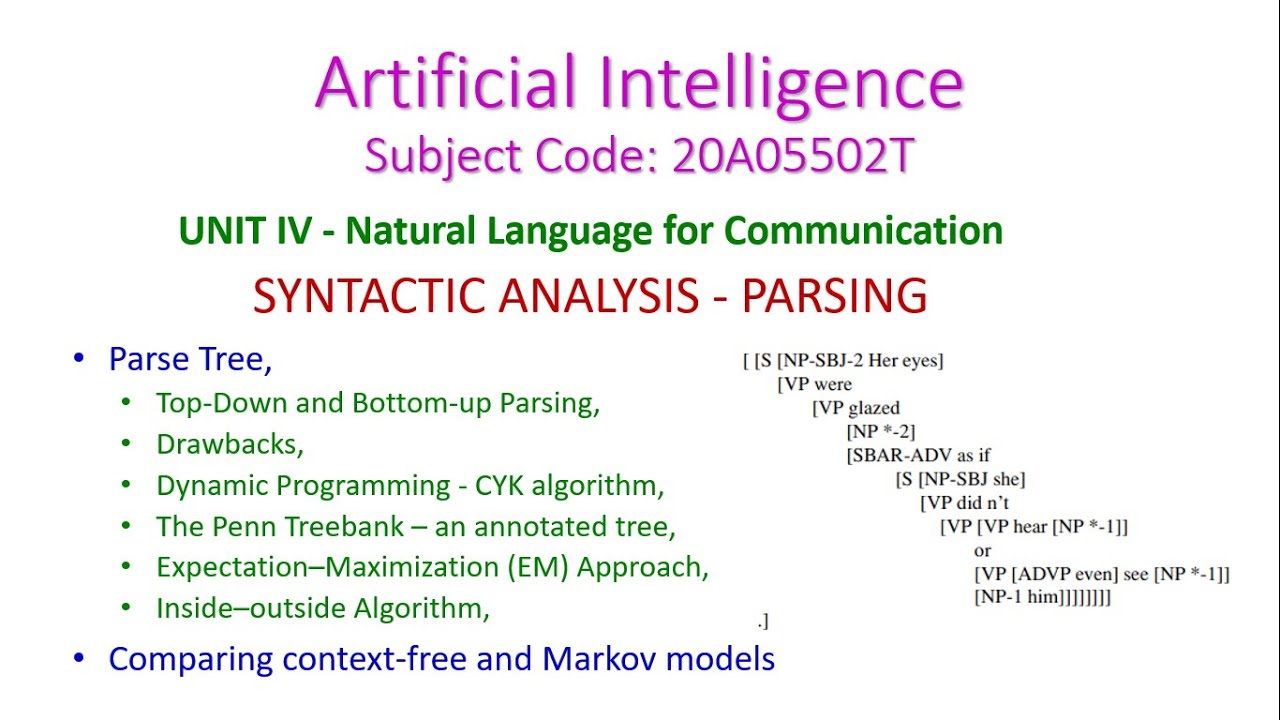
Constituency parsing groups words into nested phrases. In “the old wooden bridge,” for example, the words form a noun phrase. A constituency parse represents how smaller units combine to create larger ones, such as noun phrases, verb phrases, and complete sentences.
Dependency Parsing
Dependency parsing represents grammatical relationships between individual words. It identifies a central word, or “head,” and connects related words to it. In “She opened the window,” the parser may connect “She” to “opened” as its subject and “window” to “opened” as its object.
How Modern NLP Systems Use Syntax
Many contemporary NLP systems use machine-learning models trained on large collections of text. Some are designed specifically for tasks such as parsing, while others learn syntactic patterns as part of broader language modeling.
Even when a system does not produce an explicit parse tree, information about word order and grammatical relationships can still influence its predictions. This can help with tasks such as:
- Machine translation: Reorganizing sentence structure to fit the grammar of another language.
- Information extraction: Identifying relationships, such as who did what to whom.
- Search and question answering: Distinguishing the subject and object in a query.
- Grammar checking: Detecting possible structural errors or awkward phrasing.
- Text generation: Producing sentences with coherent grammatical structure.
Syntax and Meaning
Syntax and semantics are closely connected, but they are not the same. Syntax concerns how words are arranged and related grammatically. Semantics concerns meaning. A sentence can be syntactically well formed but still make little sense, as in “The idea drank a blue window.” Conversely, a sentence with grammatical errors may still be understandable.
Effective language processing often combines syntactic clues with meaning, context, and knowledge about the world. Syntax provides a useful structure, but it cannot resolve every ambiguity on its own.
Challenges in Syntactic Analysis
Human language is flexible and sometimes incomplete. People use slang, fragments, misspellings, and unconventional word order, especially in texts, social media posts, and speech transcripts. These forms can be difficult for systems trained mainly on edited writing.
Ambiguity is another challenge. A sentence may allow multiple valid parses, and the correct interpretation may depend on context that appears elsewhere in a conversation or document. Languages also differ in word order and grammatical marking, so techniques that work well for one language may not transfer directly to another.
The Role of Syntax in NLP Today
Syntactic analysis remains an important part of NLP, even as language technology increasingly relies on large neural models. Explicit parsing can offer clear, structured information, while learned representations can capture patterns without requiring a system to label every grammatical relationship directly.
In practice, the right approach depends on the task. Applications that need precise relationships may benefit from dedicated syntactic analysis. Others may rely on broader language models, with syntax captured implicitly through training.
Conclusion
Syntax gives NLP systems a way to analyze how words fit together in sentences. By identifying phrases, grammatical roles, and relationships between words, syntactic methods help computers process language more effectively. Although syntax alone cannot capture every aspect of meaning, it remains a valuable foundation for building language technologies that interpret and generate human communication.
7 Key Benefits of Syntax in Natural Language Processing
- Clarifies relationships between words.
- Improves sentence understanding.
- Supports accurate machine translation.
- Helps identify subjects and objects.
- Enhances information extraction.
- Strengthens grammar checking.
- Provides structure for language analysis.
Five Key Limitations of Syntactic Analysis in NLP
- Parsing can struggle with ambiguous sentences.
- Grammar rules vary across languages.
- Informal text may be difficult to analyze.
- Parsing errors can affect downstream tasks.
- Syntax alone cannot capture full meaning.
Clarifies relationships between words.
One key benefit of syntax in NLP is that it clarifies relationships between words. By identifying grammatical roles—such as the subject, verb, and object—a system can determine who is performing an action and what the action affects. This helps reduce confusion when sentences contain similar words in different arrangements and supports more accurate translation, information extraction, and text understanding.
Improves sentence understanding.
Syntax in NLP improves sentence understanding by helping computers identify how words relate to one another. By recognizing sentence structure, such as the subject, verb, and object, an NLP system can better determine who is performing an action and what the action affects. This makes it easier to interpret meaning, reduce confusion caused by ambiguous word order, and support tasks like translation, search, and question answering.
Supports accurate machine translation.
Syntax in NLP helps machine translation systems recognize how words relate to one another, including sentence roles such as subject, verb, and object. By understanding this structure, a system can preserve who did what to whom and rearrange words to follow the grammar of the target language. This can produce translations that are clearer, more natural, and less likely to change the original meaning.
Helps identify subjects and objects.
Syntax in NLP helps identify the subjects and objects in a sentence, making it easier for computers to understand who is performing an action and what or whom the action affects. For example, in “The teacher praised the student,” syntactic analysis identifies “the teacher” as the subject and “the student” as the object. This information supports accurate translation, information extraction, and question answering.
Enhances information extraction.
Syntax in NLP enhances information extraction by helping systems identify how words relate to one another in a sentence. By recognizing grammatical roles—such as the subject, verb, and object—an NLP system can more accurately determine who performed an action, what happened, and which people, places, or things were involved. This makes it easier to extract structured facts from documents, news articles, and other text, even when the same words could have different meanings in a different arrangement.
Strengthens grammar checking.
Syntax NLP strengthens grammar checking by analyzing how words relate to one another in a sentence. It can identify issues such as subject–verb agreement, misplaced modifiers, and incorrect word order, helping writing tools offer more relevant corrections than simple spell-checkers. By considering sentence structure, these systems can also explain why a phrase may be grammatically awkward and suggest clearer alternatives.
Provides structure for language analysis.
Syntax in NLP provides structure for language analysis by showing how words relate to one another within a sentence. By identifying phrases, grammatical roles, and relationships such as subject and object, NLP systems can interpret sentence organization more accurately. This structure supports tasks like translation, information extraction, and question answering, where understanding how words fit together is essential.
Parsing can struggle with ambiguous sentences.
One limitation of syntactic parsing in NLP is that ambiguous sentences can have more than one valid structure. For example, “I saw the man with the telescope” could mean that the speaker used a telescope to see the man, or that the man had a telescope. A parser may identify multiple possible interpretations, and without enough context, it can be difficult to determine which one the writer intended. This uncertainty can lead to errors in tasks such as translation, information extraction, and question answering.
Grammar rules vary across languages.
One challenge of syntax in NLP is that grammar rules vary widely across languages. Word order, agreement, sentence structure, and the way grammatical relationships are expressed can differ, so a parser designed for one language may not work well for another. Systems must account for each language’s distinct patterns, which can require specialized data and models. This is especially difficult for languages with fewer training resources, where limited examples can make accurate syntactic analysis harder.
Informal text may be difficult to analyze.
One drawback of syntax analysis in NLP is that informal text can be difficult to interpret. Social media posts, chats, and text messages often include slang, abbreviations, emojis, missing punctuation, spelling errors, and incomplete sentences. Because syntactic tools are often trained on more structured writing, they may misidentify grammatical roles or misunderstand how words relate to one another. As a result, an NLP system may struggle to accurately interpret the meaning and intent of casual communication.
Parsing errors can affect downstream tasks.
Parsing errors can affect downstream NLP tasks by giving systems an incorrect understanding of how words relate to one another. If a parser mistakes the subject for the object or attaches a phrase to the wrong part of a sentence, applications such as machine translation, information extraction, and question answering may produce inaccurate results. These errors can be especially common with ambiguous, informal, or grammatically complex text, making the quality of downstream outputs dependent on the reliability of the initial parse.
Syntax alone cannot capture full meaning.
Syntax analysis helps NLP systems identify how words relate to one another, but sentence structure alone cannot reveal a speaker’s full meaning. The same sentence can have different interpretations depending on context, tone, cultural references, or the speaker’s intent. For example, sarcasm may use grammatically ordinary words to convey the opposite of their literal meaning. To understand language more accurately, NLP systems must combine syntactic information with context, semantics, and real-world knowledge.