NLP for Speech Recognition: How Machines Turn Spoken Language into Meaning
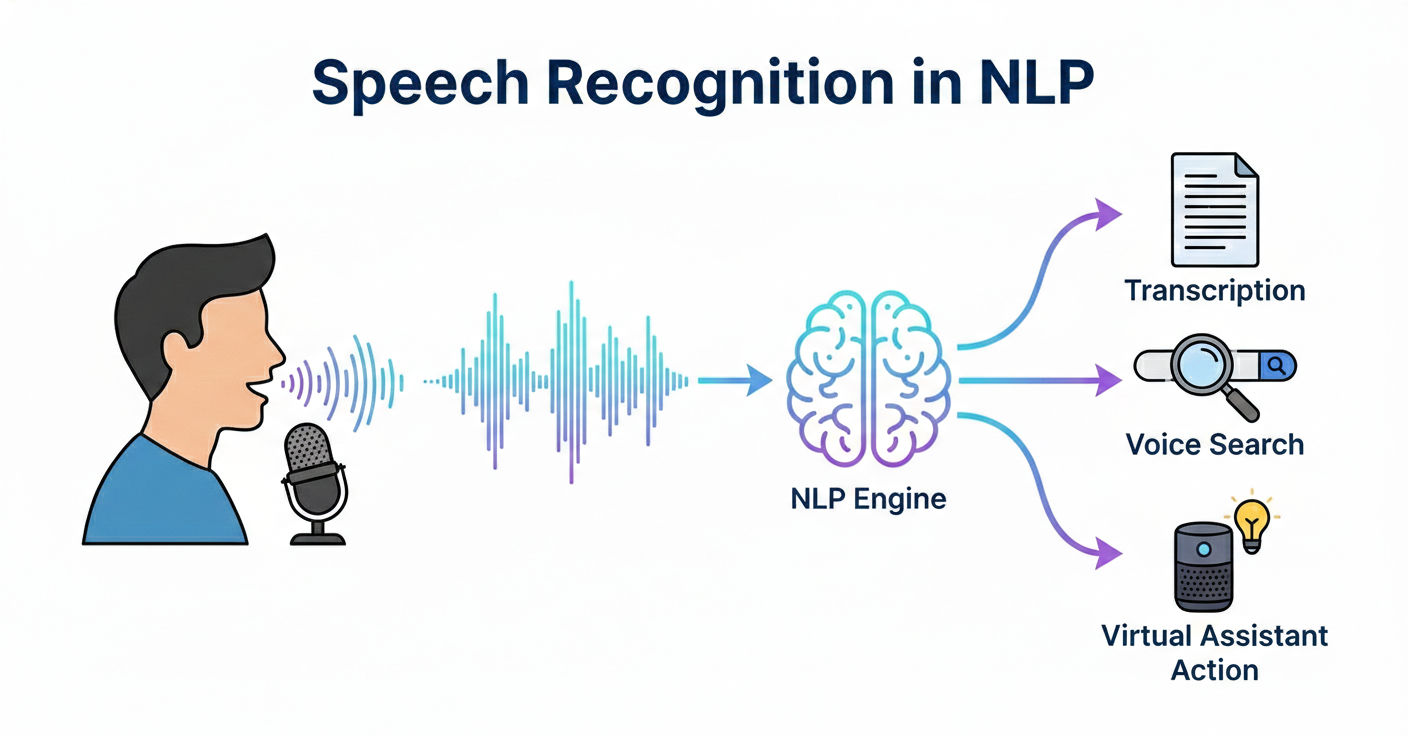
Speech recognition powers tools such as voice assistants, automated captions, dictation software, and call transcription services. These systems do more than identify sounds. To produce useful results, they also need to handle context, sentence structure, specialized vocabulary, and the unpredictable ways people speak.
Natural language processing (NLP) helps bridge the gap between recognizing spoken words and interpreting language. Combined with speech processing and machine learning, NLP makes voice-based applications more accurate, readable, and useful.
What Is NLP for Speech Recognition?
Natural language processing is a field of artificial intelligence focused on analyzing, generating, and interpreting human language. Speech recognition, often called automatic speech recognition (ASR), focuses on converting an audio signal into written text.
These fields overlap, but they are not identical. A speech recognition system answers the question, “What words were spoken?” A natural language understanding system addresses questions such as, “What does this request mean?” and “What action should follow?”
For example, consider the spoken request, “Schedule a meeting with Jordan next Friday at three.” Speech recognition produces the transcript. NLP can then identify the scheduling intent, recognize Jordan as a participant, and extract the date and time. Resolving “next Friday” also requires a reference date, while determining whether “three” means 3 a.m. or 3 p.m. may require context or clarification.
How Speech Recognition and NLP Work Together
Traditional voice systems often use separate stages for audio processing, transcription, and language understanding. Modern systems may combine several of these functions in a single model, but the underlying tasks remain useful to understand.
Processing the Audio
The system captures speech through a microphone or audio recording. Audio processing may reduce background noise, identify speech segments, and prepare the signal for recognition. Many systems represent audio as features that describe how its frequency content changes over time.
This stage primarily involves signal processing and speech technology rather than NLP. However, poor audio quality can affect every later stage.
Predicting Words from Speech
A recognition model analyzes the audio and predicts a sequence of characters, subword units, or words. Modern neural models learn relationships between speech patterns and written language from training data.
Some systems use a separate language model to help rank possible transcripts. Others learn linguistic patterns within an end-to-end recognition model. In either case, language context helps distinguish between alternatives that sound similar.
Using Context to Resolve Ambiguity
Speech contains many ambiguities. Words such as “right” and “write” sound identical in many English accents. A phrase such as “Please write down the address” provides linguistic clues that favor one interpretation.
Context can also come from the application. A medical dictation tool may need to recognize medication names, while a navigation app may prioritize street names. Vocabulary hints and domain adaptation can improve recognition, although they cannot eliminate every error.
Formatting and Interpreting the Transcript
Spoken language does not arrive with punctuation or capitalization. NLP-based post-processing can add sentence boundaries, restore capitalization, and format expressions such as dates, times, and amounts.
Additional language understanding can identify topics, extract important details, or classify a speaker’s request. For example, a support system could recognize a request to cancel a subscription and route it to the appropriate workflow.
Key NLP Techniques Used in Speech Applications
- Language modeling: Estimates likely word sequences and helps resolve uncertainty during transcription or later correction.
- Named entity recognition: Identifies names, organizations, locations, dates, and other meaningful details in a transcript.
- Intent classification: Determines whether a speaker wants to search for information, book an appointment, make a purchase, or perform another action.
- Text normalization: Converts spoken expressions into an appropriate written format, such as changing “twenty-five dollars” to “$25.”
- Contextual correction: Uses surrounding language or domain knowledge to suggest fixes for likely recognition errors.
- Summarization: Condenses transcribed conversations into key points, decisions, or action items.
Corrections require care. A fluent sentence is not necessarily an accurate transcript, and aggressive rewriting can change what a speaker actually said.
Real-World Applications
Voice Assistants and Customer Support
Voice assistants combine transcription with intent detection and information extraction to respond to spoken requests. Customer support platforms use similar capabilities to route calls, search knowledge bases, and help agents review conversations.
Healthcare Documentation
Speech recognition can turn dictated notes into text, while NLP can help organize clinical information. Medical terminology, medication names, and negation require particular attention: confusing “no history of asthma” with “history of asthma” can significantly change the meaning. Clinical review remains essential.
Accessibility and Live Captions
Automatic captions provide text access to spoken content. Punctuation and formatting can improve readability, but accuracy depends on audio conditions, vocabulary, and speaker characteristics. Some settings require professional captioning or other accommodations beyond automated output.
Speech Translation
Many speech translation systems combine speech recognition, machine translation, and optional speech synthesis. Others translate more directly from audio. In a multistage system, transcription mistakes can carry into the translation, making context and quality checks especially important.
Challenges and Limitations
Accents, dialects, background noise, overlapping speakers, and unfamiliar names remain difficult for speech recognition systems. Spontaneous speech adds interruptions, unfinished sentences, and self-corrections. Multilingual speakers may also switch languages within a single sentence.
Bias is another concern. Systems trained on unrepresentative data may perform unevenly across speaker groups. Evaluation should therefore include the accents, dialects, devices, and environments expected in actual use.
Privacy also matters. Voice recordings and transcripts may contain sensitive personal or business information. Appropriate consent, access controls, retention policies, and secure processing are important parts of deployment.
How to Evaluate a Speech Recognition System
Word error rate (WER) is a common transcription metric that measures substitutions, deletions, and insertions against a reference transcript. However, WER alone does not show whether a system captured the information that matters most.
A useful evaluation should also consider critical-term accuracy, intent detection, response time, performance across speaker groups, and the consequences of mistakes. For high-stakes applications, uncertain or consequential outputs should receive human review.
Conclusion
NLP helps speech applications move beyond raw transcription toward readable text and meaningful interaction. It supports contextual recognition, punctuation, information extraction, intent detection, and many other capabilities.
The strongest solutions combine these language capabilities with reliable audio processing, representative testing, privacy safeguards, and appropriate human oversight. The goal is not simply to produce plausible text, but to preserve what was said and support the task accurately.
5 NLP Tips for More Accurate Speech Recognition
- Use language models to predict likely word sequences.
- Normalize text consistently before training.
- Include diverse accents and speaking styles in training data.
- Use context to resolve ambiguous words.
- Evaluate accuracy across different speakers and environments.
Use language models to predict likely word sequences.
Language models help speech recognition systems choose the most likely word sequence by using context and patterns learned from language data. When a spoken sound could match multiple words, the model considers the surrounding words to rank possible transcripts—for example, distinguishing “write” from “right” based on the sentence. This can improve accuracy, especially when audio is unclear, though language models should be tuned for the relevant topic and used carefully so they don’t replace unusual but correct speech with a more common phrase.
Normalize text consistently before training.
Normalize text consistently before training so the model sees the same patterns across your dataset. Decide how to handle capitalization, punctuation, numbers, abbreviations, and spoken disfluencies, then apply those rules to every transcript. For example, avoid mixing “twenty-five” and “25” unless that variation is intentional. Consistent normalization reduces unnecessary noise, helps the model learn more reliable relationships between speech and text, and makes evaluation results more meaningful.
Include diverse accents and speaking styles in training data.
Include speakers with diverse accents, dialects, speaking rates, and communication styles in training data to help speech recognition systems perform reliably across a wider range of real-world conversations. A balanced dataset should reflect differences in pronunciation, intonation, pauses, disfluencies, and casual or formal speech—not just clean recordings from a narrow group of speakers. Test performance across these groups as well, so gaps can be identified and addressed without treating any one way of speaking as the standard.
Use context to resolve ambiguous words.
Use context to resolve ambiguous words in speech recognition. Words that sound alike—such as “right” and “write”—can be difficult to distinguish from audio alone, but the surrounding sentence often makes the intended meaning clear. By considering nearby words, the topic, and the speaker’s goal, an NLP system can choose the most likely interpretation and produce a more accurate transcript. Context should guide the decision without overriding what the audio actually supports.
Evaluate accuracy across different speakers and environments.
Evaluate speech recognition accuracy across a diverse range of speakers and environments, including different accents, speaking styles, microphone types, and levels of background noise. A system that performs well in quiet conditions for one group of speakers may struggle in real-world settings, so testing representative audio helps reveal gaps and guides improvements. Track errors by speaker group and environment, and pay special attention to mistakes that could change the meaning of a message.