NLP Meaning in Data Science: A Practical Guide
In data science, NLP stands for natural language processing. It is a field of artificial intelligence that helps computers work with human language, including text and speech. NLP combines ideas from computer science, linguistics, statistics, and machine learning to turn language into data that systems can analyze or respond to.
Natural language is often unstructured: people express the same idea in different words, use slang, make typos, or rely on context. NLP techniques help data scientists organize and interpret this information, making it possible to analyze sources such as emails, customer reviews, support chats, documents, and social media posts.
What NLP Means for Data Science
Data science is the practice of using data to answer questions, find patterns, and support decisions. NLP applies that practice to language data. Instead of working only with neatly organized rows and columns, data scientists use NLP to extract useful signals from text or speech.
For example, a company might use NLP to review thousands of product comments. A model could identify common topics, estimate whether comments express positive or negative opinions, and summarize recurring complaints. The resulting analysis can help teams understand customer concerns more quickly than reading every comment manually.
Common NLP Tasks
- Text classification: Assigning text to categories, such as labeling a message as spam or routing a support request to the right department.
- Sentiment analysis: Estimating whether a piece of text expresses a positive, negative, or neutral opinion.
- Named entity recognition: Finding names of people, organizations, locations, dates, and other entities in text.
- Information extraction: Identifying specific facts or relationships in documents, such as a product name and its price.
- Topic modeling: Discovering recurring themes across a collection of documents.
- Machine translation: Converting text from one language to another.
- Summarization: Producing a shorter version of a document while retaining its main ideas.
- Question answering and chatbots: Using language models or other NLP systems to respond to questions and support conversations.
How an NLP Workflow Works
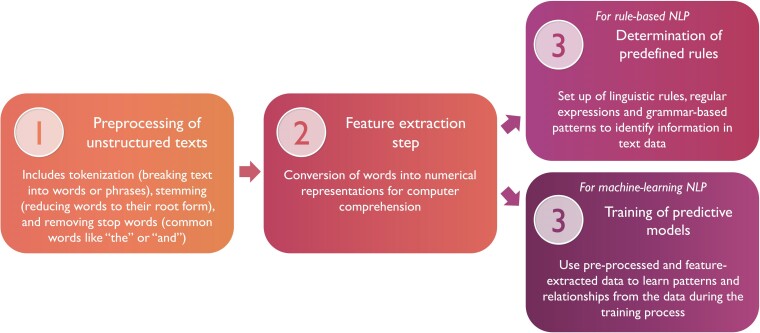
An NLP project usually involves several steps. The exact process depends on the problem, the data, and the model being used.
- Define the goal: Decide what the system should do, such as classify documents, extract key details, or answer questions.
- Collect and review data: Gather relevant text or speech and check whether it is suitable, representative, and permitted for the intended use.
- Prepare the data: Clean or format the text as needed. This may include handling missing values, removing duplicates, or correcting encoding issues.
- Represent language for a model: Convert text into a form that an algorithm can process. Traditional methods may use word counts or statistical features; modern systems often use numerical representations called embeddings.
- Choose and train or configure a model: Select an approach that fits the task. Some projects use rules or traditional machine-learning models, while others use neural networks or large language models.
- Evaluate the results: Test the system on data it has not seen before and use metrics that match the task. Human review can also be important, especially for nuanced or high-impact applications.
- Deploy and monitor: Put the system into use, track its performance, and update it when language, data, or user needs change.
NLP, Machine Learning, and Large Language Models
NLP is the broader field focused on enabling computers to process and generate human language. Machine learning is one approach used in NLP: models learn patterns from examples rather than relying only on hand-written rules. Deep learning, a type of machine learning based on neural networks, has powered many recent advances in language technology.
Large language models (LLMs) are a category of models trained on large amounts of text to recognize and generate language. They can perform tasks such as summarization, drafting, and question answering. However, they can also produce inaccurate or unsupported responses, so their outputs may need verification. LLMs are part of modern NLP, but NLP also includes many techniques and systems that do not use large language models.
Why NLP Matters in Data Science
Organizations generate large amounts of information in language form, but that information can be difficult to analyze at scale. NLP can help turn it into a more usable resource. Common applications include:
- Analyzing customer feedback and product reviews
- Sorting and prioritizing support requests
- Searching large collections of documents
- Extracting information from forms, reports, and contracts
- Monitoring public discussion and brand mentions
- Supporting translation, accessibility, and conversational tools
Challenges and Limitations
Language is complex. Words can have multiple meanings, tone can be subtle, and context can change the interpretation of a sentence. A system that performs well on one type of text may struggle with another, such as informal messages, specialized terminology, or regional expressions.
NLP systems can also reflect biases present in their training data. Privacy, security, and data permissions are important considerations when working with personal or confidential text. In addition, automated predictions should not be treated as certain facts. For sensitive decisions, organizations should use appropriate testing, human oversight, and clear accountability.
Conclusion
The meaning of NLP in data science is straightforward: natural language processing uses computational methods to analyze, understand, and generate human language. It helps data scientists work with text and speech at scale, from identifying themes in customer feedback to extracting information from documents. Effective NLP depends not only on choosing a model, but also on defining the task clearly, preparing suitable data, evaluating results carefully, and accounting for the limits of automated language systems.
NLP in Data Science: 7 Frequently Asked Questions About Its Meaning, Uses, Tools, and Challenges
- What does NLP mean in data science?
- What is natural language processing used for in data science?
- How does NLP work with text data?
- What are common NLP techniques and tasks?
- What is the difference between NLP, machine learning, and deep learning?
- What tools and programming languages are commonly used for NLP?
- What are the main challenges and limitations of NLP in data science?
What does NLP mean in data science?
In data science, NLP stands for natural language processing, a field of artificial intelligence that helps computers analyze, understand, and generate human language. Data scientists use NLP to work with text and speech—for example, to classify support requests, analyze customer reviews, translate documents, or summarize reports. It combines techniques from linguistics, statistics, and machine learning to turn language into information that can support research and decision-making.
What is natural language processing used for in data science?
In data science, natural language processing (NLP) is used to analyze, organize, and generate human language in text or speech. It helps data scientists classify documents, detect sentiment in customer feedback, extract names and key facts, summarize reports, translate languages, and build chatbots or search tools. By turning unstructured language into information that can be measured and explored, NLP helps organizations uncover patterns and make better-informed decisions.
How does NLP work with text data?
NLP works with text data by turning language into a format computers can analyze. Depending on the task, a system may first clean and split text into smaller units, such as words or sentences, then represent those units as numbers using methods like word counts or embeddings. Machine-learning models use these representations to identify patterns—for example, classify a message, detect sentiment, extract names, or summarize a document. The results are evaluated against examples or reviewed by people to check that the system performs reliably.
What are common NLP techniques and tasks?
Common NLP techniques and tasks help computers analyze, understand, and generate human language. They include text classification, such as sorting emails into spam or non-spam; sentiment analysis to identify opinions or emotions; named entity recognition to find people, organizations, and locations; and information extraction to pull specific facts from documents. Other common tasks include topic modeling, machine translation, text summarization, speech recognition, and question answering. Depending on the goal, NLP systems may use rules, statistical methods, machine learning, or large language models.
What is the difference between NLP, machine learning, and deep learning?
NLP, machine learning, and deep learning are related but distinct concepts. Natural language processing (NLP) is the field focused on helping computers analyze, understand, and generate human language. Machine learning is a way to build systems that learn patterns from data, and it can be used for NLP as well as many other tasks. Deep learning is a type of machine learning that uses multi-layered neural networks; it powers many modern NLP tools, including large language models. In short, NLP describes the language-related problem area, while machine learning and deep learning are methods that can be used to solve problems within it.
What tools and programming languages are commonly used for NLP?
Common NLP tools and programming languages include Python, which is widely used because of its extensive libraries, such as spaCy, NLTK, Hugging Face Transformers, and scikit-learn. R is also used for text analysis, with packages like tidytext and quanteda. For large-scale data processing, teams may use Apache Spark and its NLP libraries, while cloud platforms such as Google Cloud, Amazon Web Services, and Microsoft Azure offer managed language services. The right choice depends on the task, data size, team experience, and whether the project needs traditional text analysis, machine learning, or large language models.
What are the main challenges and limitations of NLP in data science?
The main challenges of NLP in data science come from the complexity and variability of human language. Words can have multiple meanings, context and sarcasm can be difficult to interpret, and slang, typos, or regional expressions may reduce accuracy. NLP models can also reflect biases in their training data, perform poorly on unfamiliar topics or language varieties, and require substantial computing resources or high-quality labeled data. Privacy and security are important when processing sensitive text, and outputs—especially those from large language models—can be inaccurate or misleading. For these reasons, NLP results should be carefully evaluated, monitored, and, when appropriate, reviewed by people.