Natural Language Processing on Text Data
Text is one of the most common forms of data. It appears in emails, customer reviews, support tickets, news articles, social media posts, and countless other sources. Natural language processing (NLP) is a field of artificial intelligence that helps computers work with this text: analyzing it, finding patterns, and generating language of their own.
Applying NLP to text data can help organizations answer practical questions. What are customers saying about a product? Which support requests need urgent attention? What topics appear most often in a collection of documents? The answers can support research, improve services, and make large volumes of information easier to navigate.
What Is Text Data?
Text data is written or transcribed language that can be processed by a computer. It may be structured, such as a product review stored in a database field, or unstructured, such as a report or a collection of social media posts. Text can also include metadata, including its author, date, language, or source.
Unlike numerical data, text does not arrive in a consistent format. People use slang, abbreviations, misspellings, emojis, and different ways to express the same idea. A computer may also need to distinguish between words with multiple meanings. For example, “bank” can refer to a financial institution or the side of a river. These qualities make text useful but challenging to analyze.
How NLP Processes Text
An NLP workflow usually begins with a clear objective. A team might want to classify messages by topic, identify names and locations in documents, or summarize long articles. The goal determines which data, methods, and evaluation measures are appropriate.
Collect and prepare the data
Text may come from documents, databases, surveys, websites, or application logs. Before analysis, it should be checked for quality and relevance. Depending on the task, preparation may include removing duplicate records, correcting encoding problems, handling missing values, and protecting personal information.
Some projects also normalize text. Common steps include converting text to a consistent case, standardizing whitespace, or removing unwanted formatting. These steps should be chosen carefully: punctuation, capitalization, and emojis can carry meaning, so removing them is not always helpful.
Break text into useful units
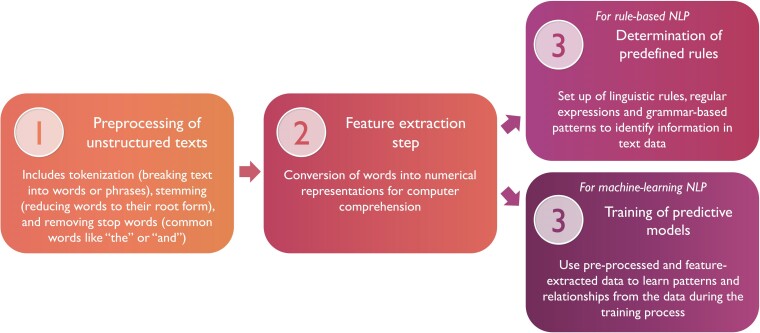
Tokenization divides text into smaller pieces, or tokens. Tokens may be words, parts of words, or characters. For example, a sentence can be divided into individual words and punctuation marks. Modern language models often use subword tokens, which help them handle unfamiliar words and different word forms.
Other linguistic steps may include identifying sentence boundaries, reducing words to their root forms, or assigning grammatical labels such as noun or verb. Whether these steps are useful depends on the task and the technology being used.
Represent language for analysis
Most machine-learning systems need text to be represented numerically. Traditional approaches count words or measure how informative a word is in a document. More recent approaches use embeddings: numerical representations designed to capture relationships between words, sentences, or documents.
For example, a search system can use embeddings to find documents that are related in meaning, even when they do not contain the exact words in a query. The choice of representation affects what a system can learn, so it should match the needs of the application.
Apply an NLP task or model
Once text is prepared and represented, a model can perform a specific task. Common NLP tasks include:
- Text classification: Assigning labels, such as topic, language, or spam status.
- Sentiment analysis: Estimating whether a message expresses a positive, negative, or neutral opinion.
- Named entity recognition: Finding references to people, organizations, locations, dates, and other entities.
- Information extraction: Turning details in text into structured fields, such as invoice numbers or product names.
- Topic modeling: Identifying recurring themes across a collection of documents.
- Search and retrieval: Finding relevant passages or documents in response to a query.
- Summarization and generation: Producing concise summaries or drafting text based on instructions and source material.
Evaluate the results
NLP systems should be tested against examples that reflect the way they will be used. For classification, measures such as precision, recall, and F1 score can provide insight into different kinds of errors. For search, teams may assess whether relevant results appear near the top. For generated text, evaluation can include factual accuracy, usefulness, safety, and review by people with subject-matter expertise.
A single score rarely tells the whole story. A system may perform well overall but struggle with a particular language, topic, or writing style. Reviewing errors and testing across relevant groups and situations helps reveal these weaknesses.
Traditional Methods and Language Models
Earlier NLP systems often relied on hand-built rules and statistical methods. These approaches can still be effective, especially when the task is narrow, the data is limited, or explanations need to be straightforward. For example, a carefully maintained set of rules may work well for recognizing a fixed format in documents.
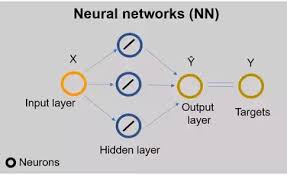
Machine-learning methods can learn patterns from examples instead of relying only on manually written rules. Deep-learning models and large language models can handle more varied language and support tasks such as summarization, question answering, and drafting. However, they may require more computing resources and careful oversight. They can also produce inaccurate or unsupported statements, so important outputs should be verified.
Common Challenges
Ambiguity and context: Words and phrases can mean different things depending on context, tone, or culture. Short messages are especially difficult to interpret reliably.
Data quality: Duplicates, incomplete text, inconsistent labels, and outdated examples can reduce the usefulness of a model. Data preparation and documentation are essential parts of an NLP project.
Bias and representation: If training data does not represent the people and language varieties a system will encounter, its performance may be uneven. Testing should include a broad range of relevant examples, and teams should consider how errors affect users.
Privacy and security: Text can contain sensitive personal, financial, or health information. Organizations should limit data collection, control access, follow applicable laws and policies, and consider whether information needs to be removed or anonymized before analysis.
Changing language: New terms, products, events, and slang can alter the meaning and frequency of words over time. NLP systems may need regular monitoring and updates to remain useful.
Practical Applications
Businesses use NLP to sort customer feedback, route support requests, search internal knowledge bases, and extract information from documents. Researchers use it to study large collections of publications or public comments. In healthcare and other regulated fields, text analysis may help organize records, but it must be designed with strong privacy protections and appropriate professional oversight.
For individuals, NLP appears in tools such as autocomplete, speech transcription, translation, spelling assistance, and conversational interfaces. These applications can save time, but users should understand their limitations—especially when the information is important or requires expert judgment.
Building a Responsible NLP Project
A successful project starts with a well-defined problem rather than a particular model. Begin by identifying who will use the results, what decisions they will support, and what a useful outcome looks like. Then select representative data, establish a baseline, and compare more advanced approaches only when they provide meaningful benefits.
It is also important to keep people involved. Human review can help verify high-impact decisions, correct model errors, and identify cases that need special handling. Clear documentation should describe the data, intended use, known limitations, and evaluation results.
Conclusion
NLP makes it possible to analyze and work with text at a scale that would be difficult to manage manually. From sorting messages to searching documents and summarizing information, it offers a range of useful techniques. Its effectiveness depends not only on the model, but also on the quality of the data, the clarity of the goal, careful evaluation, and responsible use.
NLP for Text Data: 7 Frequently Asked Questions
- What is natural language processing (NLP) for text data?
- How does NLP process and analyze text data?
- What are the most common NLP tasks for text data?
- How do you prepare text data for NLP?
- What tools and programming languages are commonly used for NLP?
- How do you evaluate the accuracy of an NLP model?
- What are the main challenges and privacy concerns when using NLP on text data?
What is natural language processing (NLP) for text data?
Natural language processing (NLP) for text data is a branch of artificial intelligence that enables computers to analyze, understand, and generate human language. It can be used to classify text, identify names and topics, detect sentiment, summarize documents, and answer questions. NLP techniques help turn unstructured text—such as emails, reviews, and reports—into useful insights, though results can depend on data quality and context.
How does NLP process and analyze text data?
NLP processes and analyzes text data through several steps. It first prepares the text by handling formatting, punctuation, or other inconsistencies, then breaks it into smaller units such as words or subwords. The text is converted into numerical representations that machine-learning models can interpret. Depending on the task, an NLP system can then classify text, identify names and topics, detect sentiment, extract information, answer questions, or generate summaries. The results are evaluated for accuracy and reviewed for issues such as bias, privacy, and errors.
What are the most common NLP tasks for text data?
The most common NLP tasks for text data include text classification, which assigns categories such as topic or spam status; sentiment analysis, which identifies opinions or emotions; named entity recognition, which detects names, places, dates, and organizations; and information extraction, which turns details in text into structured data. Other widely used tasks include text summarization, language translation, question answering, search, and topic modeling. These techniques help organize, understand, and retrieve information from large collections of documents and messages.
How do you prepare text data for NLP?
Preparing text data for NLP typically involves removing duplicates and irrelevant content, fixing encoding issues, and handling missing or inconsistent records. Depending on the task, text may be normalized by standardizing capitalization, whitespace, or spelling, then divided into tokens such as words or subwords. Remove only elements that are genuinely unhelpful, since punctuation, emojis, and capitalization can carry meaning. If the model requires labeled examples, check that labels are accurate and consistent, then split the data into training, validation, and test sets without allowing related examples to leak across them. Finally, protect sensitive information and review the prepared data to make sure it represents the language and use cases the system will encounter.
What tools and programming languages are commonly used for NLP?
Python is the most commonly used programming language for NLP, with popular libraries such as spaCy, NLTK, scikit-learn, and Hugging Face Transformers supporting tasks from text cleaning to language modeling. PyTorch and TensorFlow are often used to build and train deep-learning models, while Apache Spark and Spark NLP can process large datasets. R, Java, and JavaScript are also used in some projects, and cloud platforms offer ready-made NLP services for tasks such as translation, sentiment analysis, and entity recognition.
How do you evaluate the accuracy of an NLP model?
The accuracy of an NLP model is evaluated using a separate, labeled test set that reflects the data it will encounter in real use. The right metrics depend on the task: classification may use accuracy, precision, recall, and F1 score, while translation or summarization may require automated text-quality measures and human review. It’s also important to examine errors, test performance across different groups and writing styles, and ensure the test data was not used during training.
What are the main challenges and privacy concerns when using NLP on text data?
The main challenges of using NLP on text data include interpreting context, sarcasm, slang, and ambiguous language; handling inconsistent or low-quality data; and reducing bias so systems perform fairly across different groups and writing styles. Privacy is also a key concern because text may contain personal, financial, health, or other sensitive information—even when it appears in ordinary messages or documents. Organizations should collect only what they need, obtain appropriate consent, limit access, protect data during storage and processing, and remove or mask identifying details when possible. Because anonymized text can sometimes still be linked back to individuals, privacy protections and compliance with applicable laws should be considered throughout the project.