Different NLP Techniques: A Guide to How Computers Work with Language
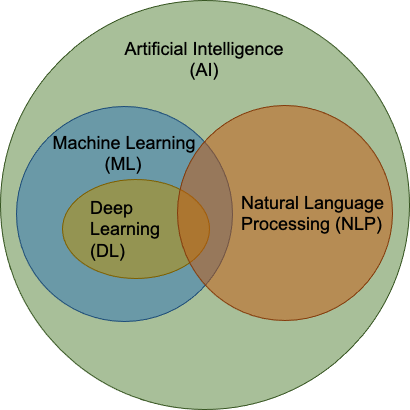
Natural language processing (NLP) is the field of computer science and artificial intelligence focused on helping computers analyze, understand, and generate human language. It powers tools such as search engines, translation apps, chatbots, voice assistants, and spam filters.
NLP combines linguistic ideas with statistical methods and machine learning. The techniques used can range from simple rules for identifying words to large neural networks that generate fluent text. Here are some of the most common approaches.
Tokenization
Tokenization breaks text into smaller units called tokens. Depending on the task, a token might be a word, part of a word, punctuation mark, or character.
For example, a basic tokenizer might split “NLP helps computers understand language” into individual words. More advanced tokenizers can handle contractions, punctuation, and languages that do not separate words with spaces. Modern language models often use subword tokens, which let them work with unfamiliar words by splitting them into smaller pieces.
Text normalization
Text normalization makes text more consistent before analysis. It may include converting text to lowercase, standardizing punctuation, correcting common spelling variations, or expanding abbreviations.
For example, a system might treat “U.S.A.” and “USA” as equivalent. The right normalization steps depend on the application: removing punctuation may help with some searches, but it could damage meaning in tasks such as sentiment analysis or code processing.
Stemming and lemmatization
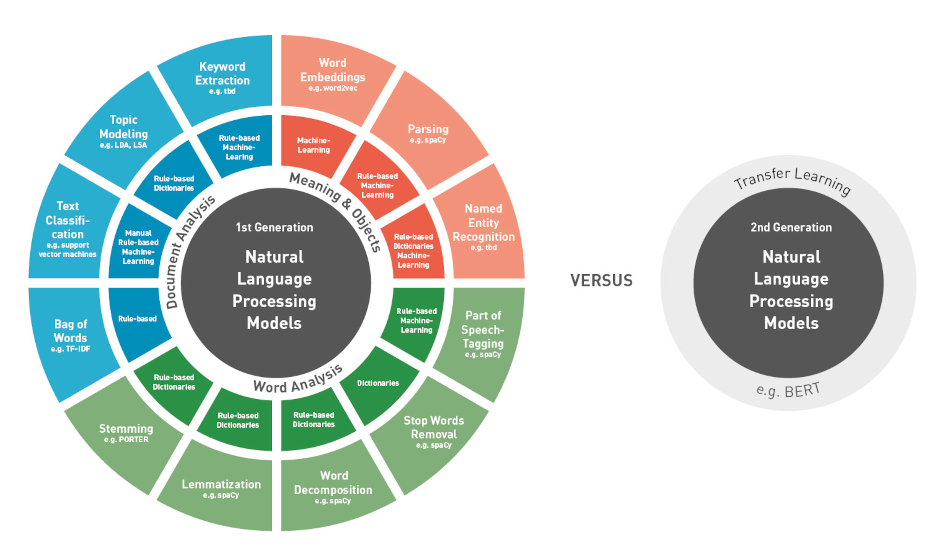
Stemming and lemmatization reduce related word forms to a common form. Stemming uses simple rules to remove word endings, so “connecting,” “connected,” and “connection” may be reduced to a shared stem. The result may not be a complete word.
Lemmatization uses vocabulary and grammatical information to find a word’s dictionary form, or lemma. For example, it can recognize that “was” and “are” are forms of “be.” Lemmatization is typically more linguistically informed, while stemming is often faster and simpler.
Part-of-speech tagging
Part-of-speech tagging identifies the grammatical role of each word, such as noun, verb, adjective, or preposition. The role can depend on context: in “book a room,” “book” is a verb, while in “read a book,” it is a noun.
These tags help systems analyze sentence structure and can support tasks such as information extraction, translation, and text-to-speech.
Syntactic parsing
Syntactic parsing examines how words relate to one another in a sentence. A dependency parser, for example, can identify which word is the subject of a verb, which word is its object, and how other words modify them.
Parsing can help clarify relationships that matter for understanding. In “The manager approved the request,” a parser can identify the manager as the person doing the approving and the request as what was approved.
Named entity recognition
Named entity recognition (NER) finds and classifies references to real-world entities in text. Common categories include people, organizations, locations, dates, and monetary amounts.
In the sentence “Jordan Lee joined Northstar Labs in Seattle in 2025,” an NER system might identify Jordan Lee as a person, Northstar Labs as an organization, Seattle as a location, and 2025 as a date.
Text classification
Text classification assigns one or more categories to a piece of text. Examples include classifying emails as spam or legitimate, assigning topics to news articles, and labeling customer messages by intent.
Traditional classification systems often use features such as word counts and phrases. Modern systems commonly use machine learning models that learn useful patterns from labeled examples.
Sentiment analysis
Sentiment analysis estimates the opinion or emotional tone expressed in text. A simple system might label a review as positive, negative, or neutral. More detailed systems can identify specific emotions or determine sentiment toward particular aspects of a product.
For example, “The screen is excellent, but the battery life is disappointing” expresses positive sentiment about the screen and negative sentiment about the battery. Context matters: sarcasm, understatement, and mixed opinions can make sentiment difficult to classify accurately.
Information extraction
Information extraction turns unstructured text into organized facts. It can identify entities, relationships, events, and attributes, then place them into a structured format such as a database.
A system processing a news report might extract who was involved in an event, where it happened, and when. This technique is useful for research, document review, and monitoring large collections of text.
Search and information retrieval
Information retrieval techniques find documents that are relevant to a query. Traditional search systems may compare keywords and rank documents using signals such as term frequency and document rarity.
Semantic search goes further by representing words, queries, and documents as numerical vectors called embeddings. This can help a system find relevant material even when the query and the document use different wording.
Word embeddings and language representations
Word embeddings represent words as numerical vectors, allowing a model to work with patterns in meaning and usage. Words that appear in similar contexts often receive similar representations.
Newer systems use contextual representations. Instead of assigning one fixed representation to a word, they account for the surrounding text. This helps distinguish the meaning of “bank” in “river bank” from its meaning in “bank account.”
Machine translation
Machine translation automatically converts text from one language to another. Earlier systems often relied on hand-written rules or statistical patterns learned from translated examples. Modern translation tools generally use neural networks, especially transformer-based models, to translate whole sequences while taking context into account.
Translation quality depends on factors such as language pair, subject matter, writing style, and the availability of high-quality training data. Human review remains important for legal, medical, and other high-stakes content.
Question answering and chatbots
Question-answering systems identify or generate responses to questions. Some search for an answer in a set of documents; others generate a response based on patterns learned during training. Chatbots combine language understanding with dialogue management to respond over multiple turns.
These systems can help with customer support, document search, and everyday information tasks. They may still misunderstand a question or produce an incorrect answer, so important claims should be checked against reliable sources.
Text summarization
Text summarization creates a shorter version of a longer text while preserving its main points. Extractive summarization selects important sentences from the original. Abstractive summarization generates new wording to express the central ideas.
Summaries can make reports, articles, and long documents easier to review. However, generated summaries may omit important details or introduce errors, especially when the source is complex or ambiguous.
Speech-related NLP
Speech applications combine NLP with audio processing. Speech recognition converts spoken language into text, while text-to-speech systems generate spoken audio from written text. Some systems also identify speakers, detect pauses, or analyze vocal emotion.
Speech recognition can be affected by background noise, accents, speaking speed, and specialized vocabulary. NLP techniques then help interpret the recognized words or produce a useful response.
Rule-based, statistical, and neural approaches
NLP techniques can also be grouped by how they work. Rule-based systems use explicit instructions written by people. They can be easy to inspect but may struggle with exceptions and changing language.
Statistical and traditional machine learning approaches learn patterns from examples. They can perform well on focused tasks, but often depend on carefully selected features and labeled data.
Neural approaches learn complex patterns from large amounts of data. Transformer models, a widely used neural architecture, can support tasks such as translation, summarization, classification, and text generation. Their flexibility can be powerful, but they may require substantial computing resources and can be difficult to interpret.
Choosing the right NLP technique
The best technique depends on the task, the available data, the language, and the consequences of an error. A keyword search may be sufficient for a small collection of documents, while semantic search may be more useful when people describe the same idea in different ways. A rule-based system may suit a narrow, predictable process, while a machine learning model may handle a wider range of language.
In practice, NLP systems often combine several techniques. A customer-support tool, for example, might use tokenization and language detection, classify a message by intent, retrieve relevant information, and then generate or select a response.
Conclusion
NLP includes a broad range of techniques for processing, analyzing, and generating human language. From tokenization and parsing to machine translation and text generation, each method solves a different part of the challenge. Understanding these approaches makes it easier to choose appropriate tools—and to recognize that even advanced language systems can make mistakes.
7 Essential NLP Techniques for Understanding and Analyzing Text
- Use tokenization to split text into manageable units.
- Apply stemming to reduce words to their roots.
- Use lemmatization to find dictionary forms of words.
- Try named entity recognition to identify names and places.
- Use sentiment analysis to detect emotional tone.
- Apply topic modeling to discover themes in documents.
- Use embeddings to compare word or sentence meaning.
Use tokenization to split text into manageable units.
Tokenization is a foundational NLP technique that breaks text into smaller, manageable units called tokens. Depending on the task, tokens may be words, punctuation marks, or parts of words. For example, a tokenizer can split “Language tools process text” into individual words, making it easier for a system to analyze meaning, identify patterns, or prepare the text for tasks such as translation and sentiment analysis.
Apply stemming to reduce words to their roots.
Stemming is a simple NLP technique that reduces related words to a shared root by removing common endings. For example, “connects,” “connected,” and “connecting” may all be reduced to “connect.” This can help search and text analysis systems recognize that different word forms are related. Because stemming relies on rules, the result may not always be a complete dictionary word, so it’s best suited to tasks where grouping word variations matters more than preserving exact meaning.
Use lemmatization to find dictionary forms of words.
Use lemmatization to reduce words to their dictionary forms, or lemmas, while considering their meaning and grammatical role. For example, a lemmatizer can recognize that “running,” “ran,” and “runs” are forms of “run.” This helps NLP systems treat related word forms consistently, improving tasks such as search, text classification, and information retrieval.
Try named entity recognition to identify names and places.
Try named entity recognition (NER) to automatically identify names, places, organizations, dates, and other key details in text. For example, NER can help extract people and locations from news articles, organize customer records, or quickly scan documents for important references. It’s a useful technique when you need to turn unstructured text into information that’s easier to search, sort, or analyze.
Use sentiment analysis to detect emotional tone.
Use sentiment analysis to identify the emotional tone of text, such as whether a customer review, social media post, or support message sounds positive, negative, or neutral. This technique can help organizations track customer opinions, spot emerging concerns, and respond more effectively. Because sarcasm, context, and mixed feelings can be difficult for automated systems to interpret, review sentiment results alongside the original text—especially when decisions have a significant impact.
Apply topic modeling to discover themes in documents.
Topic modeling can help uncover recurring themes across a large collection of documents, even when those themes aren’t labeled in advance. Techniques such as Latent Dirichlet Allocation (LDA) group words that frequently appear together, revealing topics that may be useful for organizing research, analyzing customer feedback, or exploring news coverage. For best results, clean and prepare the text carefully, experiment with different numbers of topics, and review the top words and sample documents for each topic—these models provide clues, not definitive interpretations.
Use embeddings to compare word or sentence meaning.
Use embeddings to compare the meaning of words or sentences, rather than relying only on exact keyword matches. Embeddings convert text into numerical vectors that capture aspects of meaning, so phrases with similar ideas can be recognized even when they use different wording. This makes them useful for semantic search, recommendations, clustering, and finding related content. For best results, choose an embedding model suited to your language and task, and remember that similar scores indicate related patterns—not guaranteed understanding.