Data Science and Natural Language Processing: Turning Text into Insight
Every day, people create enormous amounts of text through emails, reviews, support chats, social media posts, reports, and search queries. For organizations, this information can reveal what customers need, how public opinion is changing, and where processes could improve. Data science and natural language processing (NLP) provide the tools to find those patterns and turn unstructured text into useful insights.
What Is Data Science?
Data science is the practice of using data to answer questions and support decisions. It brings together statistics, programming, domain knowledge, and communication. A data science project might involve collecting information, cleaning it, analyzing patterns, building a predictive model, and explaining the results to stakeholders.
Data can take many forms. Tables of sales figures are structured data, while documents, conversations, and customer reviews are unstructured data. Working with unstructured data often requires specialized methods—and that is where NLP comes in.
What Is Natural Language Processing?
Natural language processing is a field of computer science and artificial intelligence focused on helping computers work with human language. NLP systems can analyze, classify, search, summarize, and generate text. They are used in tools such as translation software, chatbots, voice assistants, spam filters, and document search systems.
Language is complicated. A word can have multiple meanings, context can change the meaning of a sentence, and people use slang, abbreviations, and different writing styles. NLP combines linguistic ideas with statistical and machine-learning techniques to handle these challenges.
How Data Science and NLP Work Together
Data science provides the broader process for turning information into decisions. NLP supplies methods for extracting information from language. Together, they make it possible to analyze large collections of text in a consistent, repeatable way.
For example, a retailer could analyze thousands of product reviews. An NLP system might identify the main topics customers discuss, such as delivery, durability, or fit. A data scientist could then compare those topics across products, regions, or time periods and present the findings in a dashboard.
Common NLP Tasks
- Text classification: Assigning a category to a piece of text, such as labeling a support request as a billing or technical issue.
- Sentiment analysis: Estimating whether text expresses a positive, negative, or neutral opinion.
- Named entity recognition: Identifying names of people, organizations, locations, dates, and other entities.
- Topic modeling: Finding recurring themes across a collection of documents.
- Information extraction: Pulling specific facts, such as prices or contract dates, from text.
- Summarization: Producing a shorter version of a document while preserving key information.
- Machine translation: Converting text from one language to another.
- Question answering and search: Finding relevant information in documents in response to a query.
A Typical Text-Analysis Workflow
- Define the question. Start with a clear goal, such as reducing support response times or understanding customer feedback.
- Collect and assess text data. Identify appropriate sources and check whether the data is relevant, representative, and legally usable.
- Prepare the data. Remove duplicates, address formatting issues, and decide how to handle missing, sensitive, or irrelevant information.
- Choose an approach. Depending on the task, a project might use rules, traditional machine learning, pretrained language models, or a combination of methods.
- Evaluate performance. Test the system on data it has not seen before. Use metrics suited to the task and inspect errors, not just overall scores.
- Apply the results. Share insights with the people who need them or integrate the model into a product or business process.
- Monitor and improve. Language and user behavior change over time, so systems need ongoing evaluation and maintenance.
Choosing the Right Techniques
Not every text problem requires a large language model. Simple keyword rules may be effective for a narrow task, while traditional machine-learning methods can work well when labeled examples are available. Pretrained language models can handle more complex language tasks, but they may require additional safeguards, evaluation, and computing resources.
The best approach depends on the project’s goals, data, budget, risk level, and need for transparency. A smaller, carefully tested system may be more appropriate than a complex model when the task is straightforward or the consequences of an error are significant.
Challenges and Responsible Use
Text data can contain personal, confidential, or sensitive information. Organizations should limit access, follow applicable privacy requirements, and avoid collecting more data than necessary. They should also consider whether the data represents the people and situations the system will encounter in practice.
NLP systems can misunderstand sarcasm, dialects, cultural references, or specialized terminology. Their outputs may also reflect biases present in their training data. Human review is especially important when results affect decisions about people, such as hiring, lending, health care, or access to services.
Responsible projects document how data was collected, explain what a model can and cannot do, test performance across relevant groups, and provide a way to correct errors. Accuracy matters, but so do fairness, privacy, security, and accountability.
The Future of Data Science and NLP
Advances in language models are making it easier to work with documents and conversations, but they do not remove the need for careful data science. Strong results still depend on clear problem definitions, reliable data, appropriate evaluation, and thoughtful human oversight.
As organizations continue to generate text at scale, the combination of data science and NLP will remain valuable. Used responsibly, these methods can help people find information faster, understand large collections of feedback, and make better-informed decisions.
Data Science and NLP: 8 Frequently Asked Questions
- What is the difference between data science and natural language processing (NLP)?
- How is NLP used in data science?
- What skills do I need to work in data science and NLP?
- Which programming languages and tools are commonly used for NLP?
- How do I prepare text data for an NLP project?
- What are the most common NLP techniques and applications?
- How do I evaluate the accuracy of an NLP model?
- What challenges and ethical concerns should I consider when using NLP?
What is the difference between data science and natural language processing (NLP)?
Data science is a broad field that uses statistics, programming, and domain expertise to analyze data and solve problems. Natural language processing (NLP) is a specialized area of artificial intelligence focused on helping computers understand, analyze, and generate human language. The two fields often overlap: data scientists may use NLP techniques to extract insights from text, such as customer reviews, emails, or support conversations. In short, data science covers many types of data and methods, while NLP focuses specifically on language.
How is NLP used in data science?
NLP is used in data science to analyze and extract insights from text, such as customer reviews, emails, social media posts, and support conversations. Data scientists apply techniques like sentiment analysis, text classification, topic modeling, and named entity recognition to organize language data, identify trends, and answer business questions. These insights can support tasks such as understanding customer feedback, routing support requests, improving search, and summarizing documents.
What skills do I need to work in data science and NLP?
To work in data science and natural language processing (NLP), build a foundation in programming—especially Python—statistics, data analysis, and machine learning. Familiarity with tools such as pandas, SQL, and common machine-learning libraries is useful, along with an understanding of NLP concepts like text preprocessing, classification, embeddings, and language models. Clear communication and problem-solving skills matter, too, because the work involves translating real-world questions into analyses and explaining results to others. Depending on the role, knowledge of linguistics, cloud platforms, or data engineering may also help; practical projects are a strong way to develop and demonstrate these skills.
Which programming languages and tools are commonly used for NLP?
Python is the most widely used programming language for NLP, thanks to its extensive ecosystem of libraries, including spaCy, NLTK, Hugging Face Transformers, and scikit-learn. R is also used for text analysis, particularly in statistical research, while Java and JavaScript can be useful for production applications and web-based tools. Common supporting technologies include Jupyter notebooks for experimentation, pandas for data preparation, PyTorch or TensorFlow for deep learning, and cloud platforms for training and deploying models. The best choice depends on the project’s goals, data, and technical requirements.
How do I prepare text data for an NLP project?
Preparing text data for an NLP project starts with defining the task and collecting relevant, properly authorized text. Remove duplicates and irrelevant content, address missing or corrupted entries, and standardize formatting while preserving details that may carry meaning, such as punctuation or capitalization. Depending on the project, you may also need to split text into sentences or tokens, remove or normalize common words, and label examples for training and evaluation. Protect personal or sensitive information, keep your preprocessing steps consistent across datasets, and review samples to make sure cleaning hasn’t removed useful context.
What are the most common NLP techniques and applications?
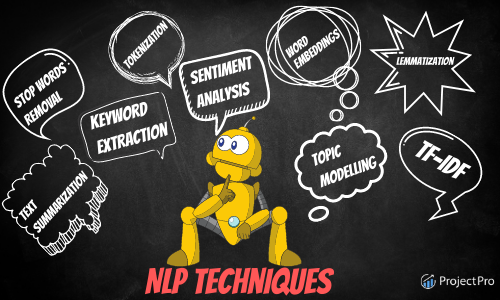
The most common natural language processing (NLP) techniques include text classification, sentiment analysis, named entity recognition, topic modeling, machine translation, text summarization, and information extraction. These methods help computers sort text into categories, identify opinions and key details, discover recurring themes, translate between languages, and create concise summaries. Common applications include spam filtering, customer feedback analysis, chatbots and virtual assistants, document search, content moderation, language translation, and routing customer support requests. The right technique depends on the task, the quality of the available data, and how the results will be used.
How do I evaluate the accuracy of an NLP model?
Evaluate an NLP model on a representative, held-out test set that it did not see during training, and choose metrics suited to its task. For classification, use precision, recall, and F1 score alongside accuracy, especially when classes are imbalanced; for translation or summarization, combine task-specific measures such as BLEU or ROUGE with human review. Check performance across important groups and real-world examples, examine common errors, and make sure the test data does not leak into training. A single score rarely tells the whole story, so pair quantitative metrics with qualitative evaluation.
What challenges and ethical concerns should I consider when using NLP?
When using NLP, consider challenges such as inaccurate or inconsistent results, difficulty understanding context, slang, sarcasm, and language variation, as well as the need for representative, high-quality data. Ethical concerns include protecting personal and sensitive information, reducing bias that could lead to unfair outcomes, and being transparent about how the system works and where it may fail. For high-impact decisions, use human review, test performance across relevant groups, and provide ways to question or correct NLP-generated results.