Lexical Analysis in NLP: How Computers Break Text Into Meaningful Units
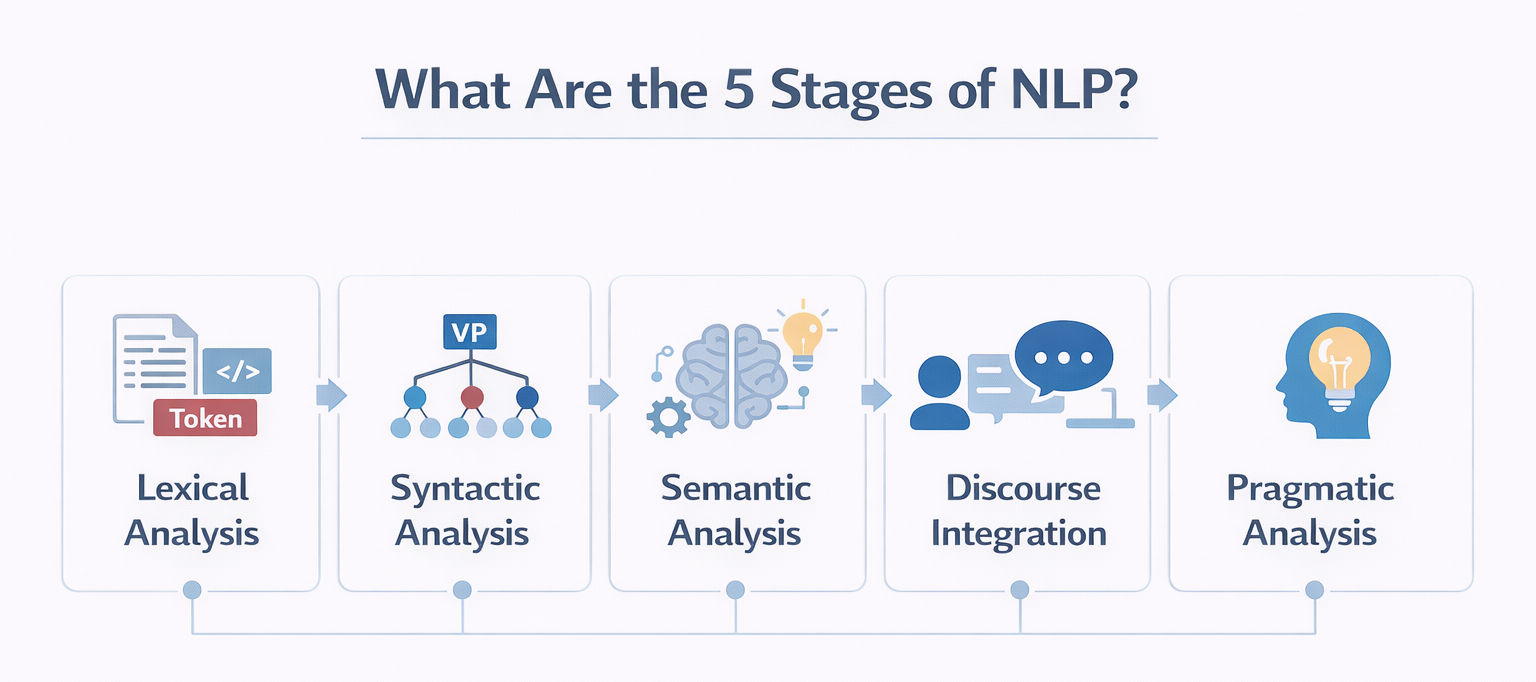
Before a computer can interpret a sentence, it needs to identify the pieces that make it up. In natural language processing (NLP), this early step is often called lexical analysis. It involves examining text and dividing it into useful units—such as words, numbers, punctuation marks, and symbols—so that later processes can analyze the text more effectively.
Lexical analysis may sound simple, but natural language makes it surprisingly complex. Words can have multiple meanings, languages use different writing systems, and even the boundaries between words can be unclear. The choices made during lexical analysis can influence nearly every NLP task that follows.
What Is Lexical Analysis?
Lexical analysis is the process of identifying and organizing the basic units in a text. These units are commonly called tokens. A token may be a complete word, part of a word, punctuation, a number, or another meaningful text element.
For example, a basic analysis of the sentence “Maya’s book arrived today!” might produce these tokens:
Maya | ’s | book | arrived | today | !
Different NLP systems may split the sentence in different ways. One system might treat “Maya’s” as a single token, while another separates “Maya” and “’s.” Neither choice is automatically correct for every task. The best approach depends on what the system needs to do.
How Lexical Analysis Works
A typical lexical-analysis pipeline can include several operations. Not every application uses all of them, and modern NLP systems may combine or reorder these steps.
Text normalization
Normalization makes text more consistent. It can include converting characters to a standard format, handling unusual spacing, or changing text to lowercase. For example, a search system might treat “NLP” and “nlp” as equivalent. However, lowercasing is not always appropriate: capitalization can help distinguish a person’s name from a common noun or identify an acronym.
Tokenization
Tokenization divides text into units. In English, spaces often indicate word boundaries, but punctuation, contractions, hyphenated terms, and URLs require additional rules. Tokenizing “We’re testing a text-to-speech tool” requires decisions about whether to split “We’re” and “text-to-speech.”
Languages without spaces between words, including Chinese and Japanese, present different challenges. A system must determine likely word boundaries from the characters and their context. Some languages also attach grammatical information to words, making segmentation more complicated.
Handling punctuation, numbers, and special characters
Punctuation can signal sentence boundaries, questions, emphasis, or abbreviations. Numbers may represent dates, prices, measurements, or identifiers. Special characters can appear in email addresses, hashtags, code, and social media posts. A lexical analyzer must decide whether to preserve, separate, or transform these elements according to the task.
Lexical normalization
Some systems map different forms of a word to a shared representation. Stemming reduces a word to a shortened base form, while lemmatization aims to identify its dictionary form. For instance, “running,” “ran,” and “runs” may be connected to the lemma “run.” These methods can help with search and text classification, although changing word forms can also remove information that matters in context.
Lexical Analysis and Tokenization
Tokenization is a central part of lexical analysis, but the terms are not always used interchangeably. Lexical analysis is the broader process of identifying and preparing text units. Tokenization specifically refers to splitting text into those units.
Traditional rule-based tokenizers often use spaces, punctuation, and language-specific rules. Many modern NLP systems use subword tokenization, which breaks words into smaller pieces. A word the system has not encountered before may be represented as a sequence of familiar parts rather than treated as one unknown item.
Subword methods are useful for handling rare words, names, and new terms. They are widely used with large language models, but they can split words in ways that are not meaningful to people. A tokenizer may divide a long technical term into several pieces simply because those pieces are common in its vocabulary.
Why Lexical Analysis Matters
Lexical analysis provides the input for many NLP applications, including:
- Search engines: Identify terms in a query and match them with relevant content.
- Machine translation: Prepare text for processing and help models recognize words or subword units.
- Sentiment analysis: Identify words and expressions that may signal positive, negative, or neutral opinions.
- Text classification: Organize documents by topic, intent, or category.
- Information extraction: Locate names, dates, locations, and other details in text.
- Speech recognition: Convert recognized speech into text units that can be analyzed further.
Errors at this stage can affect later results. If a tokenizer splits a product name incorrectly, a search system may fail to find it. If punctuation is removed without care, a question or abbreviation may be misinterpreted. Good lexical analysis helps downstream systems work with text consistently.
Common Challenges
Ambiguous word boundaries
Spaces do not always settle where one word ends and another begins. Compounds, contractions, and multiword expressions may be treated as one unit or several. In languages without spaces, boundary detection can require substantial linguistic context.
Words with multiple meanings
Lexical analysis can identify a word, but it usually cannot determine its meaning on its own. In “The crane moved the beam,” the word “crane” refers to equipment. In “A crane flew over the marsh,” it refers to a bird. Determining the intended meaning requires context and additional language-processing steps.
Informal and evolving language
Online text often includes abbreviations, misspellings, emojis, hashtags, and newly coined terms. A system designed for formal writing may not handle these elements well. Normalizing informal language can help, but excessive normalization may erase tone or meaning.
Language and domain differences
Tokenization rules vary by language, and specialized fields use their own terminology. A medical system, for example, may need to recognize technical terms that a general-purpose tokenizer treats as unfamiliar fragments. Effective lexical analysis often depends on the language, domain, and intended application.
Lexical Analysis Compared With Syntax Analysis
Lexical analysis focuses on the individual units in text. Syntax analysis, also called parsing, examines how those units relate to one another in a sentence. In “The child opened the door,” lexical analysis identifies the words and punctuation; syntax analysis determines how the words function and how they form a sentence structure.
The distinction is useful, but the processes can interact. A system may use context to decide how to split a phrase, while later syntactic analysis can reveal whether an earlier interpretation was plausible.
Best Practices for NLP Projects
There is no single tokenizer that is ideal for every use case. When choosing or designing a lexical-analysis approach, consider the language, text type, and goal of the project. Preserve information that may matter, such as capitalization, punctuation, and word boundaries. Test the system on realistic examples, including unusual names, numbers, contractions, and domain-specific vocabulary.
It is also important to use the same preprocessing approach during training and evaluation. If text is tokenized differently at each stage, a model may receive inconsistent inputs and perform less reliably.
Conclusion
Lexical analysis is a foundational part of natural language processing. By identifying and organizing the units in text, it prepares language for tasks such as search, translation, classification, and information extraction. The process involves more than splitting sentences at spaces: it requires thoughtful decisions about punctuation, word forms, language-specific rules, and context.
As NLP systems continue to evolve, lexical analysis remains essential. Whether a system uses traditional rules, subword tokens, or a combination of methods, the way it represents text helps shape what it can understand and do.
5 Practical Tips for Lexical Analysis in NLP
- Normalize text before tokenization.
- Choose tokenization rules for the language and task.
- Handle punctuation, contractions, and numbers consistently.
- Use stemming or lemmatization when appropriate.
- Check tokenization quality on real examples.
Normalize text before tokenization.
Normalize text before tokenization to make the input more consistent and easier to process. Depending on your task, normalization may include standardizing Unicode characters, handling extra spaces, converting text to lowercase, or replacing inconsistent quote marks. Apply only the changes your application needs: lowercasing, for example, can remove useful clues such as capitalization in names and acronyms. Consistent normalization helps prevent the tokenizer from treating minor formatting differences as entirely different text.
Choose tokenization rules for the language and task.
Choose tokenization rules that fit both the language and the task. Languages differ in how they mark word boundaries, and even English text can include contractions, hyphenated terms, punctuation, and specialized vocabulary that require careful handling. For example, a search system may split words to match more queries, while a text-analysis model may preserve punctuation or phrases to retain useful context. Test your rules on realistic examples to make sure they produce consistent, useful tokens.
Handle punctuation, contractions, and numbers consistently.
Handle punctuation, contractions, and numbers consistently during lexical analysis so your NLP system can interpret text reliably. Decide whether punctuation should be kept, removed, or treated as separate tokens, and apply the same rules across your data. Choose how contractions such as “don’t” and “we’re” should be split or preserved, and standardize numbers, dates, and currency values in a way that suits your task. Consistent preprocessing reduces ambiguity and helps downstream models produce more dependable results.
Use stemming or lemmatization when appropriate.
Use stemming or lemmatization when appropriate to help an NLP system recognize related forms of a word. Stemming trims words to a shared root, while lemmatization uses vocabulary and grammar to identify a word’s dictionary form—for example, connecting “running,” “ran,” and “runs” with “run.” These techniques can improve tasks such as search and text classification, but they aren’t right for every application: reducing words to their base forms may remove distinctions that matter for meaning or grammar.
Check tokenization quality on real examples.
Check tokenization quality using real examples from the text your NLP system will handle—not just clean, simple sentences. Include challenging cases such as contractions, punctuation, hyphenated terms, URLs, names, numbers, and domain-specific vocabulary. Review how the tokenizer splits each example and consider whether important meaning or formatting is lost. Testing realistic data helps reveal problems early and makes it easier to choose or adjust a tokenization approach that fits your application.