Reinforcement Learning and Natural Language Processing
Reinforcement learning and natural language processing are two important areas of artificial intelligence. Natural language processing (NLP) focuses on enabling computers to work with human language, while reinforcement learning (RL) teaches systems to make decisions through interaction, feedback, and rewards. Together, these fields help create language technologies that can respond more usefully, follow instructions, and adapt to complex tasks.
What Is Natural Language Processing?
NLP includes the methods used to analyze, understand, and generate text or speech. Common applications include translation, search, speech recognition, sentiment analysis, summarization, and conversational assistants.
Many modern NLP systems use neural networks trained on large collections of text. During training, a model learns patterns in language, such as how words relate to one another and how sentences are typically structured. This enables it to generate or interpret language, but it does not automatically ensure that its responses are accurate, helpful, or appropriate.
What Is Reinforcement Learning?
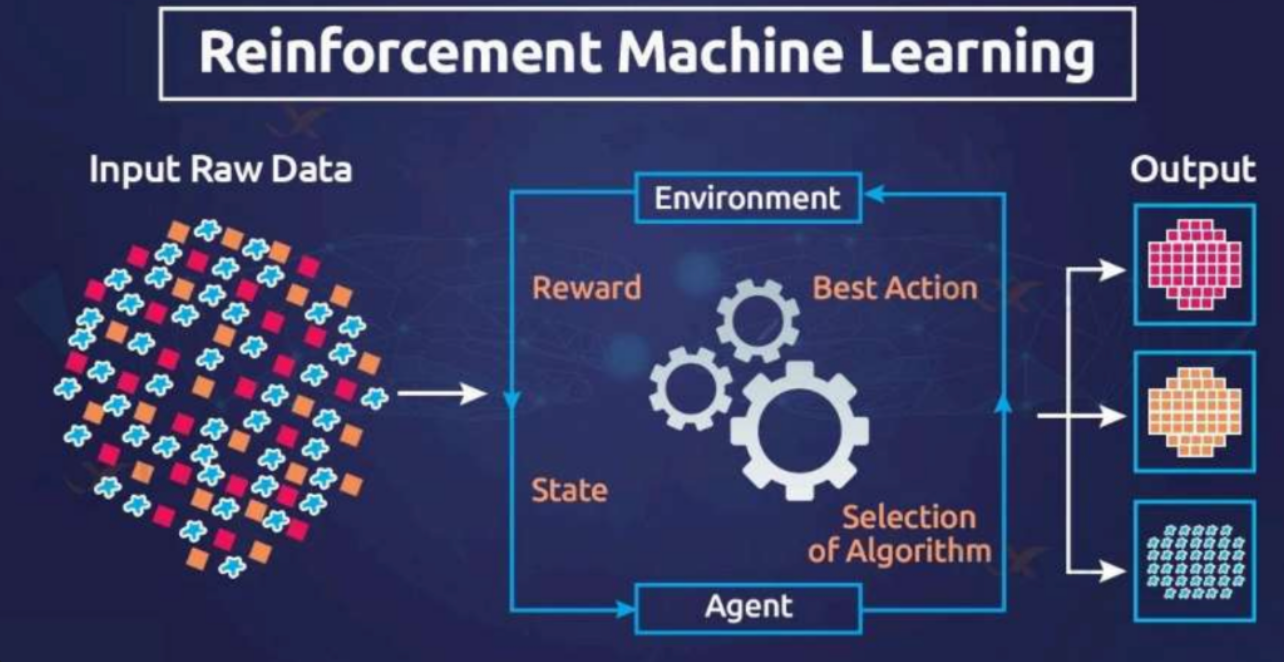
In reinforcement learning, an agent takes actions in an environment and receives feedback, often in the form of rewards or penalties. The agent aims to learn a strategy, called a policy, that produces high rewards over time.
For example, a game-playing agent may receive a reward for winning. In a language application, the “action” might be a generated response, and feedback might indicate whether that response followed instructions, answered the question, or met a user’s preferences.
How the Fields Work Together
Language models can produce fluent text but may still make mistakes or respond in ways that do not match what people want. Reinforcement learning can help refine a model’s behavior by using feedback to encourage preferred responses.
A widely discussed approach is reinforcement learning from human feedback, or RLHF. A typical process includes several stages:
- Pretraining: A language model learns general language patterns from text.
- Supervised fine-tuning: The model is trained on examples of desired responses.
- Preference feedback: Human reviewers compare or rate possible responses.
- Policy optimization: The model is further adjusted to favor responses that score well according to a learned reward signal.
The reward signal is a practical way to represent preferences, but it is not a perfect measure of quality. It can encourage useful behavior while also introducing new limitations if the feedback is incomplete or inconsistent.
Applications
Reinforcement learning and NLP can be combined in several areas:
- Conversational systems: Feedback can help assistants provide clearer, more relevant, and more instruction-following responses.
- Text summarization: A system can be optimized to produce summaries that are concise and preserve important information.
- Machine translation: Evaluation signals can help improve translations for qualities such as fluency and meaning preservation.
- Interactive tutoring: A language-based tutor can adapt its explanations and questions based on a learner’s progress.
- Information retrieval: Feedback can help a system rank results that better match a user’s intent.
Benefits and Challenges
Using reinforcement learning can make language systems more responsive to human goals than training on text alone. It can help bridge the gap between producing plausible language and completing a task in a useful way.
However, the approach has important challenges. Human judgments can differ, and collecting high-quality feedback can be costly. A reward model may also favor responses that appear convincing rather than responses that are correct. This can lead to reward hacking, where a system learns to score well without genuinely meeting the intended goal.
Language systems can also reflect biases present in their training data or feedback. In addition, reinforcement learning can make model behavior less predictable, so evaluation and safety testing remain essential. Human review, clear evaluation criteria, and ongoing monitoring can help reduce these risks, but they do not eliminate them entirely.
Beyond RLHF
RLHF is one approach to aligning language models with human preferences. Other methods use different forms of feedback or optimization. For example, some techniques train models directly on preference comparisons without using the full reinforcement-learning process. These approaches can simplify parts of training, though they still depend on the quality of the preference data and the way objectives are defined.
The broader goal is not simply to maximize a numerical reward. It is to build systems that are useful, reliable, transparent about uncertainty, and appropriate for their intended use.
Conclusion
Reinforcement learning gives NLP systems a way to learn from feedback, while NLP provides the language capabilities needed for communication and text-based tasks. Their combination has helped shape modern conversational assistants and other interactive language tools. As these systems continue to develop, careful feedback design, robust testing, and attention to safety will be just as important as improvements in model capability.
7 Essential Tips for Mastering Reinforcement Learning in NLP
- Start with a clear reward signal.
- Use small, reliable training environments.
- Check for reward hacking.
- Compare against simple baselines.
- Evaluate language models on held-out prompts.
- Track fluency, accuracy, and safety.
- Tune learning rates and update sizes carefully.
Start with a clear reward signal.
Start with a clear reward signal that defines what success looks like for your NLP task. Whether you want a chatbot to give accurate answers, a summarizer to preserve key information, or a translation system to produce fluent and faithful text, make the goal specific and measurable. A well-designed reward helps guide learning in the right direction, while vague or incomplete rewards can encourage responses that score well but miss the user’s actual needs.
Use small, reliable training environments.
Use small, reliable training environments when applying reinforcement learning to NLP. A controlled setup with clear goals, consistent feedback, and a limited set of tasks makes it easier to see how a model responds to rewards and identify problems early. Once the model performs reliably, gradually introduce more varied and complex language scenarios. This step-by-step approach can make training more stable and results easier to evaluate.
Check for reward hacking.
Check for reward hacking by asking whether the system is genuinely meeting its goal or merely finding shortcuts that earn a high reward. In reinforcement learning for NLP, a model might produce answers that sound confident, include favored keywords, or satisfy a scoring rule without being accurate or useful. Test it with varied examples, compare reward scores with human judgments, and review unexpected outputs. If the reward metric can be gamed, refine it and add safeguards before relying on the system.
Compare against simple baselines.
When applying reinforcement learning to NLP, compare your system against simple baselines, such as a supervised model, a basic heuristic, or a version that does not use reinforcement learning. These comparisons show whether the added complexity actually improves results, rather than merely making the system harder to train and evaluate. Use consistent datasets and metrics, and include human evaluation when qualities like clarity, relevance, or helpfulness are difficult to measure automatically. A strong baseline also helps reveal which parts of the approach are contributing value and where further work is needed.
Evaluate language models on held-out prompts.
Evaluate language models on held-out prompts that were not used during training or tuning to see how well they handle new situations. Include a diverse range of topics, instructions, and edge cases, and assess responses for accuracy, relevance, clarity, and safety. This helps reveal overfitting and provides a more reliable measure of whether reinforcement learning has improved the model’s behavior beyond the examples it has already seen.
Track fluency, accuracy, and safety.
When applying reinforcement learning to natural language processing, track fluency, accuracy, and safety as distinct measures of quality. Fluency shows whether responses are clear and natural, accuracy checks that they are factually correct and relevant, and safety helps identify harmful, biased, or otherwise inappropriate outputs. Evaluating all three—rather than relying on a single reward score—provides a more balanced picture of model performance and helps reveal trade-offs that need attention.
Tune learning rates and update sizes carefully.
In reinforcement learning for NLP, tune learning rates and update sizes carefully to keep training stable and preserve the language model’s existing capabilities. Updates that are too large can cause erratic behavior, degrade fluency, or make the model overfit to noisy feedback, while updates that are too small may lead to slow or negligible improvement. Monitor training and evaluation metrics, test changes on representative prompts, and adjust gradually so the model learns the desired behavior without losing reliability.