In the realm of Natural Language Processing (NLP), algorithms play a crucial role in enabling computers to understand, interpret, and generate human language. These algorithms are the backbone of many NLP applications, from machine translation to sentiment analysis, and they continue to evolve and improve as technology advances.
One of the key challenges in NLP is processing the inherent complexity and ambiguity of human language. Algorithms in NLP are designed to handle this complexity by breaking down language into its fundamental components, such as words, phrases, and syntax. These algorithms use various techniques, including statistical models, machine learning, and deep learning, to extract meaning from text and make sense of linguistic patterns.
One common type of algorithm used in NLP is the Natural Language Understanding (NLU) algorithm. NLU algorithms are designed to analyze and interpret human language by identifying entities, relationships, and sentiments within a text. These algorithms help computers understand the meaning behind words and sentences, allowing them to respond intelligently to user queries or generate coherent text.
Another important class of algorithms in NLP is the Natural Language Generation (NLG) algorithms. NLG algorithms are used to produce human-like text based on structured data or input. These algorithms can be found in chatbots, virtual assistants, and automated content generation tools, where they generate responses or content that mimic natural human language.
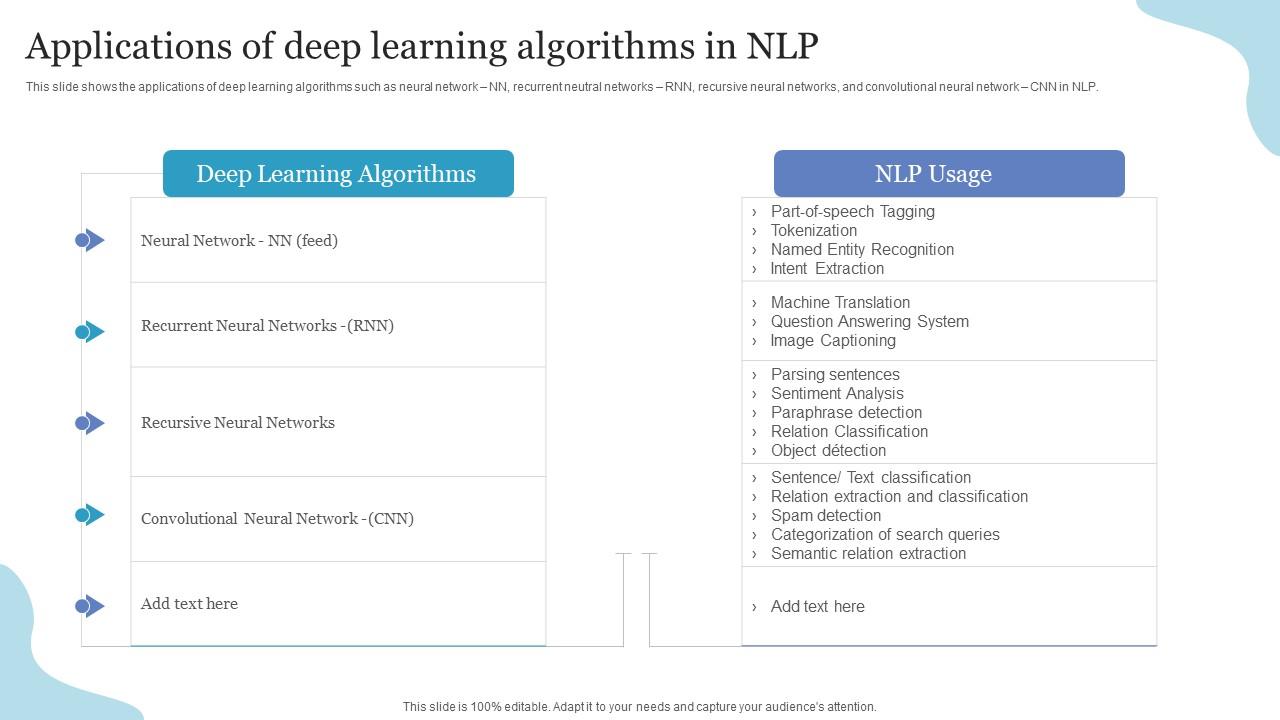
Recent advancements in deep learning have revolutionized NLP by enabling more sophisticated algorithms that can learn complex patterns and relationships in language data. Deep learning models such as recurrent neural networks (RNNs) and transformer models have significantly improved the performance of NLP tasks like language translation, text summarization, and sentiment analysis.
Overall, algorithms in NLP continue to drive innovation in artificial intelligence and enable a wide range of applications that enhance human-computer interaction. As research progresses and technology evolves, we can expect even more powerful and efficient algorithms that push the boundaries of what is possible in natural language processing.
8 Essential Tips for Optimizing NLP Algorithms
- Understand the problem domain thoroughly before choosing or designing an algorithm.
- Preprocess and clean the text data to improve algorithm performance.
- Consider using pre-trained models for common NLP tasks to save time and resources.
- Experiment with different algorithms and hyperparameters to find the best model for your specific task.
- Optimize algorithms for efficiency, especially when dealing with large datasets.
- Regularly evaluate and fine-tune algorithms to maintain optimal performance over time.
- Incorporate techniques like word embeddings and attention mechanisms to enhance algorithm capabilities.
- Avoid overfitting by using techniques like cross-validation and regularization during algorithm training.
Understand the problem domain thoroughly before choosing or designing an algorithm.
To effectively tackle challenges in Natural Language Processing (NLP), it is crucial to thoroughly understand the problem domain before selecting or creating an algorithm. By gaining a deep understanding of the specific linguistic nuances, context, and objectives of the problem at hand, one can make informed decisions about which algorithms are best suited for the task. This approach ensures that the chosen algorithm aligns closely with the requirements of the NLP problem, leading to more accurate results and efficient solutions.
Preprocess and clean the text data to improve algorithm performance.
To enhance the performance of algorithms in Natural Language Processing (NLP), it is essential to preprocess and clean the text data before feeding it into the system. By removing noise, irrelevant information, and inconsistencies from the text data, preprocessing helps improve the accuracy and efficiency of NLP algorithms. Techniques such as tokenization, lowercasing, removing stopwords, and stemming or lemmatization can standardize the text data and make it more conducive for analysis, ultimately leading to better outcomes in language processing tasks.
Consider using pre-trained models for common NLP tasks to save time and resources.
When delving into Natural Language Processing (NLP), it is advisable to leverage pre-trained models for common tasks to streamline processes and optimize resource utilization. By utilizing pre-trained models, such as language models like BERT or GPT-3, developers can expedite the development of NLP applications and achieve higher accuracy levels without the need to train models from scratch. This approach not only saves time and resources but also allows for faster deployment of NLP solutions, ultimately enhancing efficiency and effectiveness in language processing tasks.
Experiment with different algorithms and hyperparameters to find the best model for your specific task.
To optimize your Natural Language Processing (NLP) tasks, it is essential to experiment with various algorithms and hyperparameters to discover the most effective model for your specific needs. By testing different combinations of algorithms and tuning hyperparameters, you can fine-tune your NLP model to achieve the best performance and accuracy for the task at hand. This iterative process of experimentation allows you to tailor the model to the unique characteristics of your data and optimize its ability to understand, interpret, and generate human language effectively.
Optimize algorithms for efficiency, especially when dealing with large datasets.
When working with algorithms in Natural Language Processing (NLP), it is essential to optimize them for efficiency, particularly when handling large datasets. By optimizing algorithms, we can improve processing speed and reduce resource consumption, making it easier to analyze and extract insights from vast amounts of text data. Efficient algorithms ensure that NLP applications can run smoothly and effectively, enabling faster response times and better performance when dealing with the complexities of language processing tasks.
Regularly evaluate and fine-tune algorithms to maintain optimal performance over time.
To ensure optimal performance in Natural Language Processing (NLP) applications, it is essential to regularly evaluate and fine-tune algorithms. By continuously assessing the performance of algorithms and making necessary adjustments, developers can adapt to changing language patterns, improve accuracy, and enhance overall efficiency. This iterative process of evaluation and refinement helps maintain the effectiveness of NLP algorithms over time, ensuring that they continue to deliver high-quality results in various language processing tasks.
Incorporate techniques like word embeddings and attention mechanisms to enhance algorithm capabilities.
To enhance algorithm capabilities in Natural Language Processing (NLP), it is beneficial to incorporate advanced techniques such as word embeddings and attention mechanisms. Word embeddings allow algorithms to represent words as dense vectors in a continuous vector space, capturing semantic relationships between words and improving the model’s understanding of language. Attention mechanisms, on the other hand, enable algorithms to focus on specific parts of the input sequence when making predictions, enhancing performance in tasks like machine translation and text summarization. By integrating these techniques into NLP algorithms, we can significantly improve their accuracy, efficiency, and overall effectiveness in processing human language data.
Avoid overfitting by using techniques like cross-validation and regularization during algorithm training.
To enhance the performance and generalization of algorithms in NLP, it is crucial to avoid overfitting by implementing techniques such as cross-validation and regularization during the training process. By utilizing cross-validation, the algorithm’s performance can be assessed on multiple subsets of the data, helping to prevent it from memorizing noise or irrelevant patterns. Regularization techniques, on the other hand, help control the complexity of the model and prevent it from fitting too closely to the training data. These strategies play a vital role in ensuring that NLP algorithms can effectively generalize to new, unseen data and produce reliable results in various language processing tasks.