NLP and Computational Linguistics: How Computers Work with Language
People use language to share ideas, ask questions, tell stories, and get things done. Teaching computers to work with language is much more complicated than matching words to definitions. A computer must often account for context, grammar, ambiguity, and the way meaning changes across situations. Two closely connected fields tackle this challenge: natural language processing (NLP) and computational linguistics.
What Is Natural Language Processing?
Natural language processing is a branch of artificial intelligence focused on enabling computers to analyze, understand, and generate human language. NLP powers tools people encounter every day, including translation apps, voice assistants, search engines, chatbots, and automated captioning.
NLP systems can process written language, spoken language, or both. Depending on their purpose, they may identify the topic of a document, convert speech to text, answer a question, summarize a report, or generate a response.
What Is Computational Linguistics?
Computational linguistics studies language using computational methods. It draws on linguistics, computer science, mathematics, and statistics to create models of how language works and to develop algorithms that can process it.
The field asks questions such as: How can a computer represent sentence structure? What clues help a system identify the meaning of a word in context? How can language data be used to test a theory about grammar or language use?
How the Fields Are Connected
NLP and computational linguistics overlap substantially, and the terms are sometimes used interchangeably. A useful distinction is that NLP often emphasizes building practical systems, while computational linguistics can place more emphasis on modeling and analyzing language. In practice, researchers and engineers frequently work across both areas.
For example, a team developing a translation tool might use linguistic insights about word order and grammar, computational models trained on translated text, and software engineering techniques to deliver a usable product. The project is both an application of NLP and an example of computational linguistics.
Common NLP Tasks
- Tokenization: Dividing text into units such as words, punctuation marks, or subword pieces.
- Part-of-speech tagging: Identifying grammatical roles, such as noun, verb, or adjective.
- Parsing: Analyzing how words relate to one another within a sentence.
- Named entity recognition: Finding and classifying references to people, organizations, places, dates, and other entities.
- Sentiment analysis: Estimating the attitude or opinion expressed in a piece of text.
- Machine translation: Producing text in one language from text written in another.
- Summarization: Creating a shorter version of a document while preserving its key information.
- Speech processing: Converting speech to text or generating spoken language from text.
How NLP Systems Learn from Language
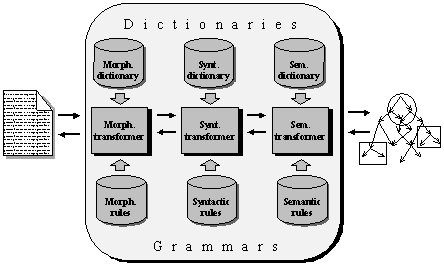
Many modern NLP systems are trained on large collections of text or speech. During training, a model learns patterns in the data. Depending on its design, it might learn to predict the next word, classify a message, match a question with an answer, or translate between languages.
Earlier approaches often relied on hand-written rules and carefully designed features. These methods remain useful in some settings, especially when transparency or precise control is important. Statistical machine-learning methods later enabled systems to learn patterns from examples. Today, many widely used tools rely on neural networks, including large language models that can perform several language tasks.
Training data alone does not guarantee a reliable system. The quality, coverage, and representation of that data matter. So do the model’s design, evaluation process, and the way people use its output.
Why Language Is Difficult for Computers
Human language is full of ambiguity. The word “bank,” for instance, can refer to a financial institution or the side of a river. Context helps people choose the intended meaning, but a computer must infer that context from available information.
Language also changes across regions, communities, and situations. People use slang, abbreviations, humor, indirect requests, and references that depend on shared knowledge. Even a grammatically simple sentence can be difficult to interpret if the speaker’s intent is unclear.
Other challenges include low-resource languages with limited digital data, differences in writing systems, and speech variation caused by accents or background noise. Systems can also reflect biases present in their training data, or produce convincing-sounding text that is inaccurate. These limitations make careful testing and human oversight important, particularly in high-impact settings.
Where NLP and Computational Linguistics Are Used
Language technologies support a wide range of applications. Businesses use them to organize customer feedback, route support requests, and search large document collections. Educators and students may use speech recognition, writing assistance, or language-learning tools. Health care and public services can use NLP to help organize information, though sensitive applications require strong safeguards and expert review.
Researchers also use computational methods to study language itself. They can analyze large text collections to investigate vocabulary, dialect differences, changes in word use, or patterns across genres. These tools can help answer questions that would be difficult to explore by reading every document manually.
The Future of Language Technology
As language models and other NLP tools develop, systems are becoming more capable of working across languages, formats, and tasks. Progress will depend not only on larger models, but also on better data, effective evaluation, transparent design, and attention to the needs of the people who use these systems.
NLP and computational linguistics bring together the study of language and the power of computing. Their shared goal is to make communication between people and machines more useful and accessible—while recognizing that language is complex, culturally shaped, and never just a collection of words.
Top 5 Benefits of NLP in Computational Linguistics: Enhancing Automation, Search, Translation, Analysis, and Interaction
- Automates language-based tasks.
- Enables faster information search.
- Supports translation across languages.
- Helps analyze large text collections.
- Powers more natural human-computer interaction.
Challenges in NLP: Bias, Context Limitations, Language Barriers, and Accuracy Issues
- Can reflect biases in training data.
- Often struggles with context and sarcasm.
- Works poorly with low-resource languages.
- May produce inaccurate or misleading results.
Automates language-based tasks.
One major advantage of NLP and computational linguistics is their ability to automate language-based tasks quickly and consistently. These technologies can sort messages, transcribe speech, translate text, summarize documents, and identify important information—work that would otherwise take people considerable time. By handling repetitive language tasks at scale, NLP tools can help individuals and organizations save time and focus on work that requires human judgment and expertise.
Enables faster information search.
NLP and computational linguistics make it faster to find useful information in large collections of text. Instead of relying only on exact keywords, these technologies can recognize related terms, interpret questions, and identify relevant details across documents, websites, and databases. This helps people get more useful search results with less time spent sorting through information.
Supports translation across languages.
One of the key benefits of NLP and computational linguistics is their ability to support translation across languages. By analyzing patterns in multilingual text, these technologies can help translate messages, documents, and websites quickly, making information more accessible to people around the world. While automated translation may miss cultural nuance or context, it can make everyday communication easier and help people connect across language barriers.
Helps analyze large text collections.
One major advantage of NLP and computational linguistics is their ability to analyze large collections of text quickly and consistently. These tools can identify recurring themes, keywords, sentiment, and patterns across thousands or even millions of documents—work that would take people far longer to complete manually. This makes it easier for researchers, businesses, and organizations to discover useful insights in sources such as customer feedback, news articles, surveys, and historical records.
Powers more natural human-computer interaction.
One of the key benefits of NLP and computational linguistics is that they make human-computer interaction feel more natural. Instead of relying only on buttons, menus, or rigid commands, people can ask questions, give instructions, and share information in everyday language. This makes technologies such as voice assistants, chatbots, and search tools easier to use and more accessible, helping people communicate with computers in ways that feel familiar and intuitive.
Can reflect biases in training data.
One important drawback of NLP systems is that they can reflect biases in the data used to train them. If that data contains stereotypes, unequal representation, or historical discrimination, a system may reproduce or even reinforce those patterns in its predictions and generated text. This can lead to unfair results—for example, treating certain names, dialects, or groups differently. Reducing this risk requires diverse, carefully reviewed training data, ongoing testing, and human oversight.
Often struggles with context and sarcasm.
One common drawback of NLP is that it can struggle to understand context, sarcasm, and other forms of indirect communication. The same phrase can mean different things depending on the situation, tone, or shared knowledge between speakers, and written text often lacks clues such as facial expressions or vocal emphasis. As a result, an NLP system may interpret a sarcastic comment literally or misunderstand what someone intends, leading to responses that feel inaccurate or out of place.
Works poorly with low-resource languages.
One major drawback of NLP is that it often works poorly with low-resource languages, which have limited digital text, speech recordings, and other training data. Without enough representative examples, systems may struggle to understand grammar, regional expressions, spelling variations, or cultural context, leading to inaccurate translations and unreliable results. This can leave speakers of less widely digitized languages with fewer useful language tools than speakers of languages with abundant online data.
May produce inaccurate or misleading results.
A major drawback of NLP and computational linguistics is that their systems can produce inaccurate or misleading results. A model may misunderstand context, miss sarcasm, rely on incomplete or biased data, or generate confident-sounding information that is not true. These errors can affect translations, summaries, search results, and other automated tasks. For that reason, NLP outputs should be checked carefully—especially when they inform important decisions or are shared as factual information.