Understanding NLP Machine Learning Models: Revolutionizing Language Processing
Natural Language Processing (NLP) has become a cornerstone of modern technology, enabling machines to understand, interpret, and respond to human language in ways that were once thought impossible. At the heart of this transformation are NLP machine learning models, which have revolutionized how we interact with technology.
What is an NLP Machine Learning Model?
An NLP machine learning model is a computational framework designed to process and analyze large volumes of natural language data. These models leverage advanced algorithms and statistical methods to understand the intricacies of human language, including syntax, semantics, and context.
Machine learning models in NLP can perform a variety of tasks such as language translation, sentiment analysis, text summarization, and more. By learning from vast datasets, these models can recognize patterns and make predictions about new data they encounter.
Key Components of NLP Models
- Tokenization: This process involves breaking down text into smaller units called tokens. These tokens can be words or phrases that serve as the basic building blocks for further analysis.
- Part-of-Speech Tagging: This step involves assigning parts of speech (nouns, verbs, adjectives) to each token. It helps the model understand the grammatical structure of sentences.
- Syntactic Parsing: Syntactic parsing determines the grammatical structure of a sentence by identifying relationships between words.
- Semantic Analysis: This component focuses on understanding the meaning behind words and phrases within their context.
The Role of Deep Learning in NLP
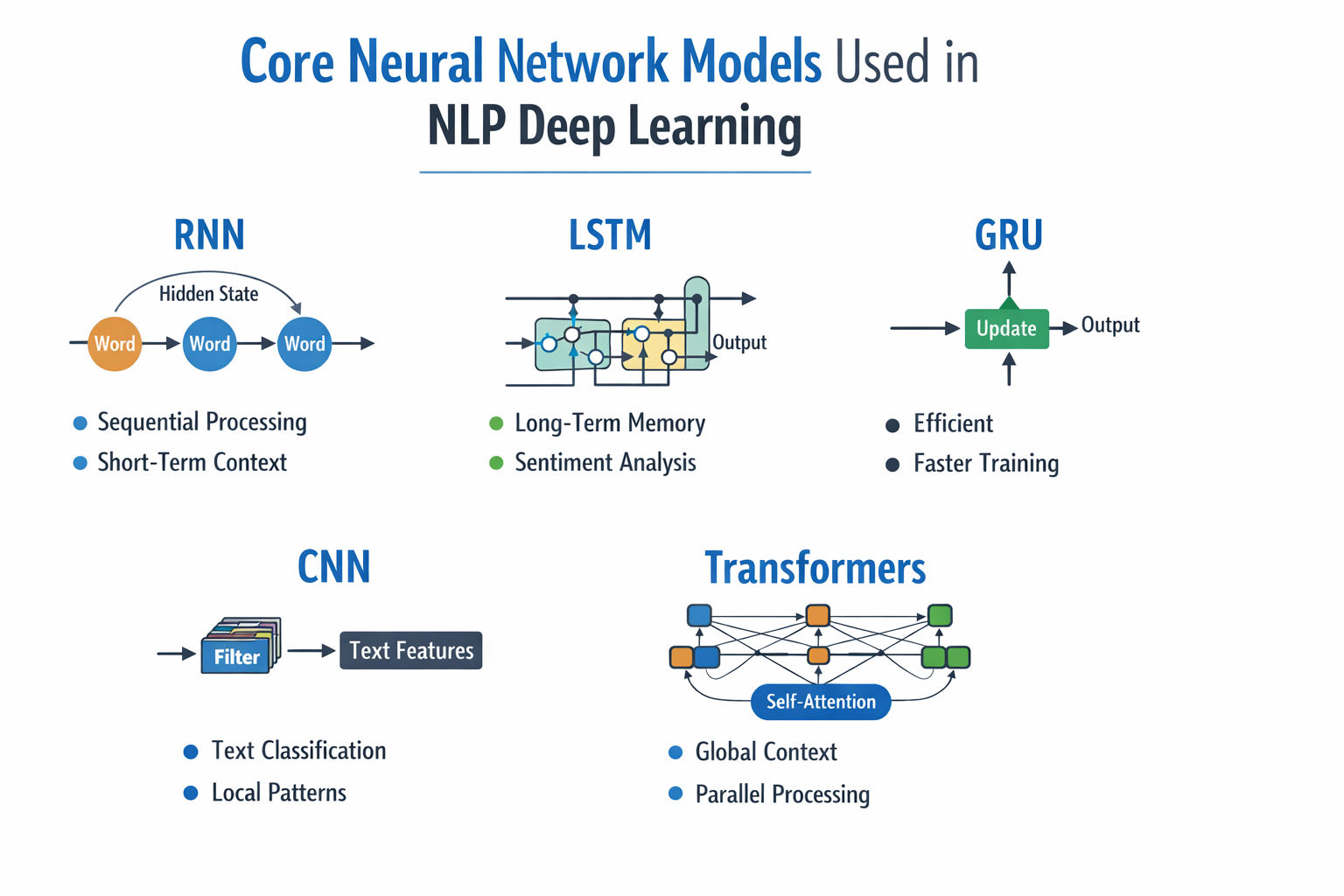
The advent of deep learning has significantly enhanced the capabilities of NLP models. Deep learning architectures like recurrent neural networks (RNNs), convolutional neural networks (CNNs), and transformers have enabled more sophisticated processing by capturing complex patterns in data.
The transformer model, in particular, has been groundbreaking for its ability to process sequences in parallel rather than sequentially. This innovation underpins popular language models such as BERT (Bidirectional Encoder Representations from Transformers) and GPT (Generative Pre-trained Transformer), which excel at a wide range of language tasks due to their robust contextual understanding.
Applications of NLP Machine Learning Models
NLP machine learning models are used across various industries:
- Customer Service: Chatbots powered by NLP can handle customer inquiries efficiently and provide personalized responses.
- E-commerce: Product recommendation systems utilize sentiment analysis to tailor suggestions based on customer reviews.
- Healthcare: NLP aids in processing medical records for improved patient care and research insights.
- Linguistics Research: Researchers use these models to study linguistic patterns and trends across different languages.
The Future of NLP Machine Learning Models
The future holds exciting prospects for NLP as machine learning continues to evolve. With ongoing research into more efficient algorithms and better handling of diverse languages and dialects, we can expect even more accurate and nuanced language processing capabilities. As these technologies advance, they will further bridge communication gaps globally and enhance our interactions with machines in increasingly intuitive ways.
NLP machine learning models are not just transforming technology; they are reshaping how humans communicate with it—making it an essential field to watch as we move forward into an increasingly digital world.
5 Essential Tips for Building Effective NLP Machine Learning Models
- Preprocess text data by removing stopwords, punctuation, and special characters.
- Use word embeddings like Word2Vec or GloVe to represent words as dense vectors.
- Consider using recurrent neural networks (RNNs) or transformers for sequence modeling tasks.
- Fine-tune pre-trained language models such as BERT or GPT for better performance on specific NLP tasks.
- Evaluate your model using metrics like accuracy, precision, recall, and F1-score to assess its performance.
Preprocess text data by removing stopwords, punctuation, and special characters.
To enhance the performance of NLP machine learning models, it is crucial to preprocess text data by eliminating stopwords, punctuation marks, and special characters. By removing these elements that do not carry significant meaning or context, the model can focus on the essential words and phrases that convey the intended message. This preprocessing step helps improve the accuracy and efficiency of language processing tasks by simplifying the input data and enabling the model to better extract meaningful patterns and insights from the text.
Use word embeddings like Word2Vec or GloVe to represent words as dense vectors.
To enhance the performance of NLP machine learning models, a valuable tip is to utilize word embeddings such as Word2Vec or GloVe to represent words as dense vectors. By converting words into continuous vector representations, these embeddings capture semantic relationships and contextual information, enabling the model to better understand the meaning and context of words within a given text. This approach not only improves the efficiency of language processing tasks but also enhances the overall accuracy and effectiveness of NLP algorithms by providing a more nuanced understanding of language nuances and relationships.
Consider using recurrent neural networks (RNNs) or transformers for sequence modeling tasks.
When delving into sequence modeling tasks within natural language processing (NLP), it is highly recommended to consider leveraging recurrent neural networks (RNNs) or transformers. RNNs are adept at capturing sequential dependencies in data, making them ideal for tasks where context plays a crucial role. On the other hand, transformers have revolutionized NLP with their parallel processing capabilities and robust contextual understanding, particularly beneficial for handling large-scale language models and complex sequences. By incorporating RNNs or transformers into your NLP machine learning model, you can enhance its ability to analyze and interpret sequential data effectively, leading to more accurate and insightful results.
Fine-tune pre-trained language models such as BERT or GPT for better performance on specific NLP tasks.
To enhance the performance of NLP tasks, a valuable tip is to fine-tune pre-trained language models like BERT or GPT. By fine-tuning these advanced models on specific datasets related to the task at hand, such as sentiment analysis or text classification, the models can adapt and learn domain-specific nuances, leading to improved accuracy and effectiveness in handling targeted NLP tasks. Fine-tuning pre-trained language models allows for a more tailored approach that optimizes their capabilities for specialized applications, ultimately enhancing overall performance and results in the realm of natural language processing.
Evaluate your model using metrics like accuracy, precision, recall, and F1-score to assess its performance.
When working with NLP machine learning models, it is crucial to evaluate their performance using key metrics such as accuracy, precision, recall, and F1-score. These metrics provide valuable insights into how well the model is performing in tasks like text classification, sentiment analysis, or language translation. Accuracy measures the overall correctness of predictions, while precision focuses on the proportion of correctly predicted positive instances. Recall evaluates the model’s ability to identify all relevant instances within a dataset. The F1-score combines precision and recall into a single metric, offering a balanced assessment of the model’s performance. By analyzing these metrics, you can gain a comprehensive understanding of your NLP model’s effectiveness and make informed decisions for further optimization.