Understanding AI, Machine Learning, and Deep Learning
In recent years, the terms Artificial Intelligence (AI), Machine Learning (ML), and Deep Learning have become buzzwords in the tech industry. While they are often used interchangeably, each represents a distinct area of study and application within the broader field of computer science.
Artificial Intelligence (AI)
Artificial Intelligence is the overarching concept that refers to machines designed to simulate human intelligence. AI encompasses a wide range of technologies and approaches that enable computers to perform tasks that typically require human intelligence, such as recognizing speech, making decisions, or translating languages.
The goal of AI is to create systems that can function intelligently and independently. This includes everything from simple rule-based systems to more complex algorithms capable of learning from data.
Machine Learning (ML)
Machine Learning is a subset of AI focused on developing algorithms that allow computers to learn from and make predictions or decisions based on data. Instead of being explicitly programmed to perform specific tasks, ML systems use statistical techniques to improve their performance as they are exposed to more data over time.
There are several types of machine learning:
- Supervised learning: The algorithm learns from labeled training data and makes predictions based on this input-output mapping.
- Unsupervised learning: The algorithm identifies patterns in unlabeled data by finding hidden structures without explicit instructions.
- Reinforcement learning: The algorithm learns by interacting with its environment and receiving feedback in the form of rewards or penalties.
Deep Learning
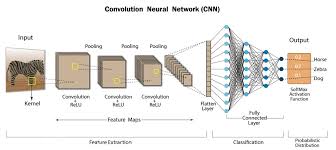
Deep Learning is a specialized subset of machine learning inspired by the structure and function of the human brain’s neural networks. It involves training large neural networks with many layers (hence “deep”) on vast amounts of data to recognize complex patterns.
This approach has been particularly successful in areas such as image recognition, natural language processing, and autonomous driving. Deep learning models require significant computational power but can achieve remarkable accuracy when trained properly.
The Interconnection Between AI, ML, and Deep Learning
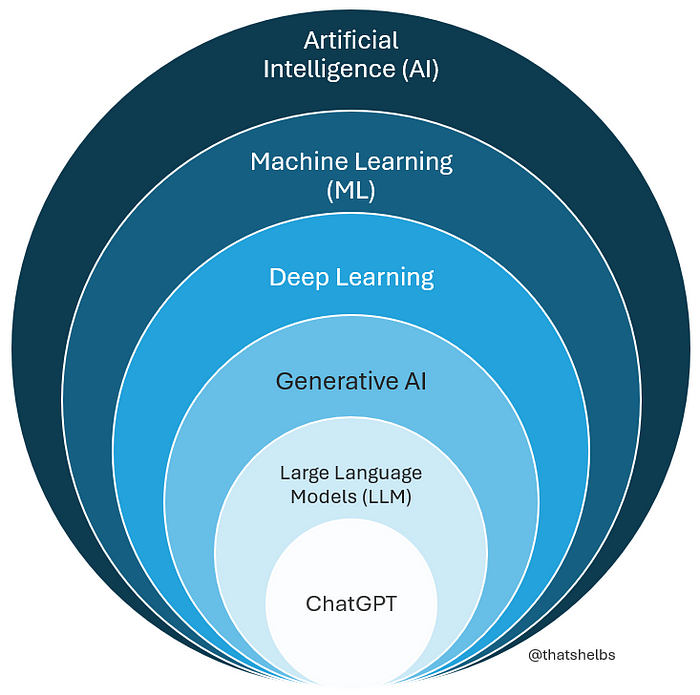
The relationship between these three fields can be visualized as concentric circles: deep learning is a subset within machine learning, which in turn is a subset within artificial intelligence. Each layer builds upon the foundations laid by its predecessor:
- AI: The broadest concept encompassing any technique enabling computers to mimic human intelligence.
- ML: A method for achieving AI through systems that learn from data rather than following pre-programmed rules.
- Deep Learning: An advanced form of ML using neural networks with many layers for high-level pattern recognition tasks.
The Future Impact
The advancements in AI, machine learning, and deep learning have already begun transforming industries across the globe. From healthcare diagnostics powered by deep neural networks to personalized recommendations on streaming platforms driven by machine learning algorithms—these technologies are becoming integral parts of everyday life.
The future holds even more promise as researchers continue pushing boundaries towards creating smarter systems capable not only performing complex tasks but also understanding context nuances like humans do—a true testament potential these transformative technologies possess reshaping world around us!
The future impact will likely see further integration into various sectors leading better efficiencies improved decision-making capabilities ultimately enhancing quality life globally!
Understanding AI, ML, and Deep Learning: Key Concepts and Applications
- What is Artificial Intelligence (AI)?
- How does Machine Learning (ML) differ from traditional programming?
- What are the key differences between Supervised and Unsupervised Learning?
- What is Deep Learning and how does it work?
- What are some common applications of AI, ML, and Deep Learning in real-world scenarios?
- How can businesses leverage AI, ML, and Deep Learning to improve their operations?
What is Artificial Intelligence (AI)?
Artificial Intelligence (AI) refers to the simulation of human intelligence processes by machines, particularly computer systems. These processes include learning, reasoning, problem-solving, perception, and language understanding. AI aims to create systems that can perform tasks typically requiring human intelligence, such as recognizing speech, making decisions, or translating languages. AI technologies are powered by algorithms and models that allow machines to process large amounts of data, identify patterns, and make informed decisions or predictions. The ultimate goal of AI is to develop systems that can operate autonomously and improve their performance over time through experience and data analysis.
How does Machine Learning (ML) differ from traditional programming?
Machine Learning (ML) differs from traditional programming in the way that it approaches problem-solving and task completion. In traditional programming, developers explicitly write code that instructs a computer on how to perform a specific task or solve a particular problem based on predefined rules and logic. On the other hand, in Machine Learning, algorithms are designed to learn from data and improve their performance over time without being explicitly programmed for every possible scenario. ML systems can generalize patterns from data and make predictions or decisions based on new information, whereas traditional programs execute predefined instructions without the ability to adapt to new situations autonomously. This fundamental difference allows Machine Learning to handle complex tasks and make decisions in dynamic environments where traditional programming may fall short.
What are the key differences between Supervised and Unsupervised Learning?
When exploring the realm of artificial intelligence, machine learning, and deep learning, a frequently asked question revolves around the key differences between Supervised and Unsupervised Learning. In Supervised Learning, algorithms are trained on labeled data, where the input data is paired with corresponding output labels. The goal is for the algorithm to learn a mapping function from input to output during the training process. On the other hand, Unsupervised Learning involves algorithms that work with unlabeled data to discover hidden patterns or structures within the data itself without explicit guidance. This distinction in approach fundamentally shapes how these two types of learning models operate and what kind of problems they are best suited to solve in various applications across different domains.
What is Deep Learning and how does it work?
Deep Learning is a subset of Machine Learning that involves training artificial neural networks with multiple layers to recognize patterns and make decisions based on vast amounts of data. In essence, Deep Learning mimics the structure and function of the human brain’s neural networks to enable machines to learn from experience and improve their performance over time. These deep neural networks process data through layers of interconnected nodes, where each layer extracts increasingly complex features from the input data. By iteratively adjusting the weights and biases in these connections during training, the network can accurately classify images, understand speech, translate languages, and perform other high-level tasks. The power of Deep Learning lies in its ability to automatically discover intricate patterns and relationships in data without explicit programming, making it a key technology driving advancements in artificial intelligence across various industries.
What are some common applications of AI, ML, and Deep Learning in real-world scenarios?
In real-world scenarios, Artificial Intelligence (AI), Machine Learning (ML), and Deep Learning technologies are being increasingly utilized across various industries to revolutionize processes and enhance efficiency. Common applications of these technologies include personalized recommendations in e-commerce platforms, predictive maintenance in manufacturing, fraud detection in finance, natural language processing for virtual assistants, image recognition in healthcare diagnostics, autonomous driving in transportation, and sentiment analysis in social media monitoring. These applications demonstrate the versatility and transformative power of AI, ML, and Deep Learning in addressing complex challenges and driving innovation across different sectors.
How can businesses leverage AI, ML, and Deep Learning to improve their operations?
Businesses can leverage the power of Artificial Intelligence (AI), Machine Learning (ML), and Deep Learning to enhance their operations in numerous ways. By implementing AI-driven solutions, businesses can automate repetitive tasks, streamline processes, and make data-driven decisions with greater accuracy and efficiency. Machine Learning algorithms can analyze vast amounts of data to uncover valuable insights, predict trends, and optimize resource allocation. Deep Learning techniques enable businesses to develop advanced models for image recognition, natural language processing, and more complex pattern recognition tasks. Ultimately, by harnessing the capabilities of AI, ML, and Deep Learning, businesses can gain a competitive edge, improve customer experiences, increase productivity, and drive innovation across various sectors.