Understanding AI, Machine Learning, and Deep Learning
In recent years, terms like Artificial Intelligence (AI), Machine Learning (ML), and Deep Learning have become buzzwords across various industries. While they are often used interchangeably, each represents a distinct concept with unique applications and implications.
Artificial Intelligence: The Broad Umbrella
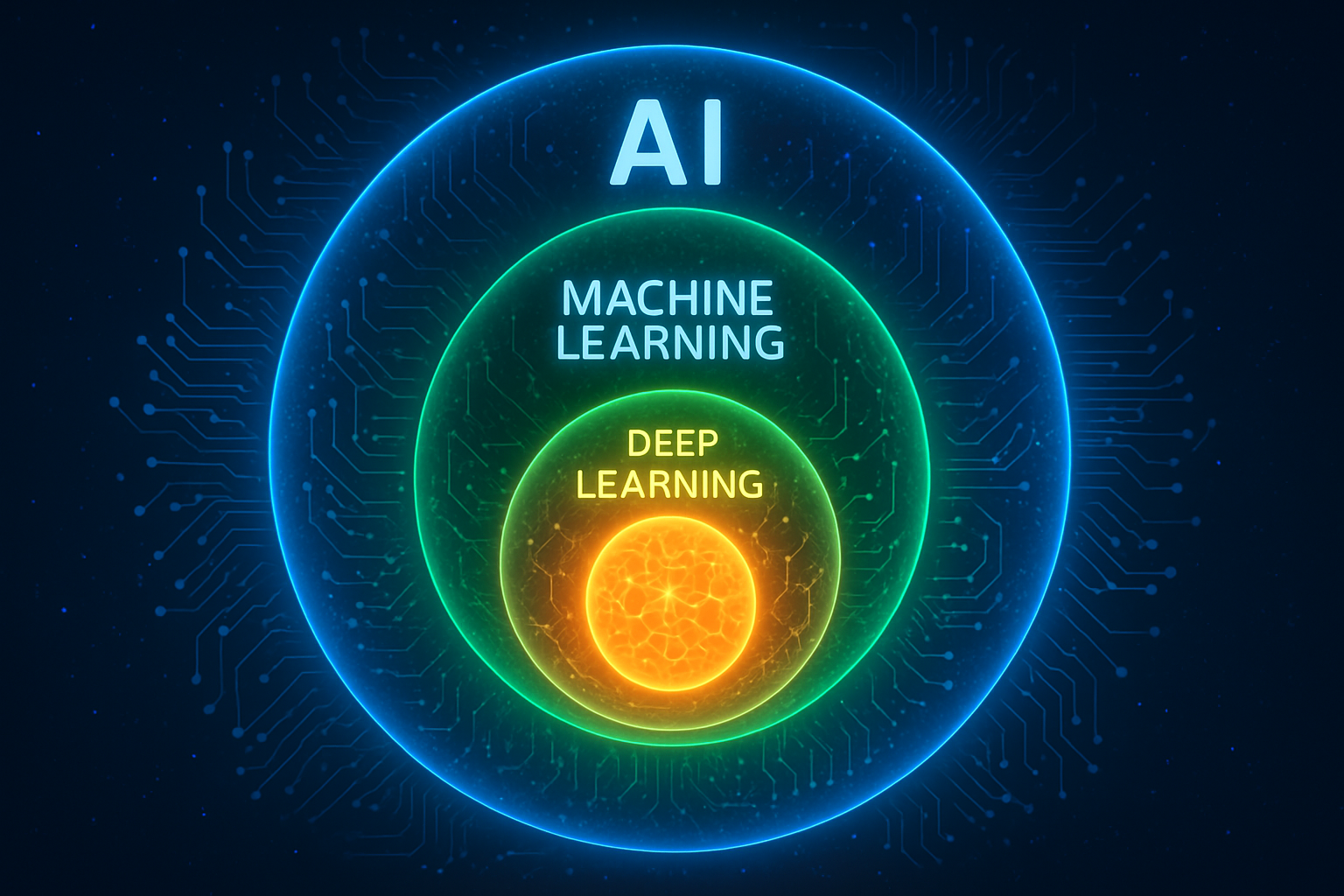
Artificial Intelligence is the overarching field that focuses on creating machines capable of performing tasks that typically require human intelligence. These tasks include problem-solving, understanding language, recognizing patterns, and making decisions. AI can be categorized into two types: narrow AI, which is designed for specific tasks like voice assistants or recommendation systems; and general AI, which aims to perform any intellectual task that a human can do.
Machine Learning: A Subset of AI
Machine Learning is a subset of AI that involves training algorithms to learn from data and improve over time without being explicitly programmed. It focuses on the development of algorithms that can access data and use it to make predictions or decisions. The primary goal of ML is to enable computers to learn automatically through experience.
There are several types of machine learning:
- Supervised Learning: Involves training a model on labeled data, where the correct output is known. It’s commonly used in applications like spam detection and image recognition.
- Unsupervised Learning: Deals with unlabeled data and seeks to find hidden patterns or intrinsic structures within the input data. Clustering algorithms are a typical example.
- Semi-supervised Learning: Combines both labeled and unlabeled data for training. This approach is useful when acquiring a fully labeled dataset is expensive or time-consuming.
- Reinforcement Learning: Focuses on training models through trial and error by rewarding desired behaviors while penalizing undesired ones. It’s often used in robotics and game playing.
Deep Learning: Diving Deeper into ML
Deep Learning is an advanced subset of machine learning inspired by the structure and function of the human brain’s neural networks. It involves using multi-layered neural networks to process complex patterns in large datasets. This approach has revolutionized fields such as computer vision, natural language processing (NLP), and speech recognition due to its ability to achieve high accuracy levels.
The key innovation in deep learning is its use of layers—often referred to as deep neural networks—where each layer progressively extracts higher-level features from raw input data. This hierarchical feature extraction makes deep learning particularly powerful for tasks involving unstructured data such as images or text.
The Future of Intelligent Systems
The synergy between AI, machine learning, and deep learning continues to drive innovation across various sectors including healthcare, finance, automotive industries, among others. As these technologies evolve further with advancements in computational power and availability of big data resources—the potential applications seem limitless—from autonomous vehicles navigating complex environments safely—to personalized medicine tailored uniquely for individual patients based on genetic profiles!
The journey towards truly intelligent systems may still be unfolding but understanding how these technologies interrelate provides valuable insight into their transformative potential—and perhaps most importantly—their role shaping our future world!
7 Essential Tips for Mastering AI, Machine Learning, and Deep Learning
- Understand the basics of AI, machine learning, and deep learning concepts.
- Choose the right algorithms based on the type of data and problem you are working on.
- Preprocess and clean your data to ensure quality input for training models.
- Split your data into training and testing sets to evaluate model performance accurately.
- Regularly update and fine-tune your models to improve accuracy and efficiency.
- Consider interpretability and ethics when deploying AI/ML models in real-world applications.
- Stay updated with the latest trends and advancements in AI, machine learning, and deep learning.
Understand the basics of AI, machine learning, and deep learning concepts.
To effectively navigate the realm of AI, machine learning, and deep learning, it is crucial to grasp the fundamental concepts underlying these technologies. By understanding the basics of AI, machine learning, and deep learning, individuals can gain insight into how these systems operate, their applications, and their potential impact on various industries. This foundational knowledge serves as a solid framework for exploring more advanced topics and staying abreast of the latest developments in artificial intelligence.
Choose the right algorithms based on the type of data and problem you are working on.
When working with AI, machine learning, and deep learning, selecting the appropriate algorithm is crucial to achieving optimal results. The choice of algorithm largely depends on the type of data you have and the specific problem you’re trying to solve. For instance, if your data is labeled and you need to make predictions or classifications, supervised learning algorithms like decision trees or support vector machines might be suitable. On the other hand, if you’re dealing with unlabeled data and need to identify patterns or groupings, unsupervised learning techniques such as clustering algorithms could be more effective. For complex tasks involving image or speech recognition, deep learning models like convolutional neural networks (CNNs) are often preferred due to their ability to handle high-dimensional data. By carefully considering the nature of your data and the problem at hand, you can select an algorithm that maximizes efficiency and accuracy in your AI endeavors.
Preprocess and clean your data to ensure quality input for training models.
Preprocessing and cleaning your data is a crucial step in ensuring quality input for training AI, machine learning, and deep learning models. This process involves removing noise, handling missing values, normalizing data, and transforming raw data into a format that can be easily understood by algorithms. By doing so, you enhance the accuracy and efficiency of your model’s predictions. Clean data helps prevent misleading results and reduces the risk of overfitting or underfitting, which can occur when models learn from irrelevant or erroneous information. Ultimately, investing time in thorough data preprocessing sets a solid foundation for building robust and reliable models that deliver meaningful insights and actionable outcomes.
Split your data into training and testing sets to evaluate model performance accurately.
Splitting your data into training and testing sets is a crucial tip in the realm of AI, machine learning, and deep learning. By dividing your dataset into separate portions for training and testing, you can effectively evaluate your model’s performance and generalization ability. The training set is used to train the model on patterns in the data, while the testing set serves as a benchmark to assess how well the model performs on unseen data. This practice helps prevent overfitting and provides a more accurate representation of how your model will perform in real-world scenarios.
Regularly update and fine-tune your models to improve accuracy and efficiency.
Regularly updating and fine-tuning your AI, machine learning, and deep learning models is crucial for maintaining their accuracy and efficiency. As data evolves and new patterns emerge, models can become outdated if not periodically adjusted to reflect these changes. Fine-tuning involves making small adjustments to the model’s parameters or architecture to enhance its performance on current data. This process helps in reducing errors, improving predictive capabilities, and ensuring that the models remain relevant in dynamic environments. Additionally, regular updates allow the incorporation of new data, which can lead to better generalization and robustness of the model. By consistently refining models, organizations can leverage AI technologies more effectively to achieve optimal results in various applications.
Consider interpretability and ethics when deploying AI/ML models in real-world applications.
When deploying AI/ML models in real-world applications, it is crucial to consider interpretability and ethics. Ensuring that these models are transparent and understandable is essential for building trust with users and stakeholders. Additionally, incorporating ethical considerations into the development and deployment process helps mitigate potential biases and ensures that the technology is used responsibly and ethically. By prioritizing interpretability and ethics, organizations can harness the power of AI, machine learning, and deep learning while promoting accountability and fairness in their applications.
Stay updated with the latest trends and advancements in AI, machine learning, and deep learning.
To stay ahead in the rapidly evolving fields of AI, machine learning, and deep learning, it is crucial to stay updated with the latest trends and advancements. By keeping abreast of new technologies, research breakthroughs, and industry developments, individuals can enhance their knowledge, skills, and capabilities in these cutting-edge domains. Continuous learning and staying informed about the latest innovations will not only help professionals remain competitive but also enable them to leverage the full potential of AI, machine learning, and deep learning in their work and projects.